DEF 14A: Definitive proxy statements
Published on April 23, 2026
UNITED STATES
SECURITIES AND EXCHANGE COMMISSION
Washington, D.C. 20549
________________________________________________
SCHEDULE 14A
Proxy Statement Pursuant to Section 14(a) of the
Securities Exchange Act of 1934
(Amendment No. )
________________________________________________
Filed by the Registrant ☒
Filed by a Party other than the Registrant ☐
Check the appropriate box:
☐ Preliminary Proxy Statement
☐ Confidential, for Use of the Commission Only (as permitted by Rule 14a-6(e)(2))
☒ Definitive Proxy Statement
☐ Definitive Additional Materials
☐ Soliciting Material under § 240.14a-12
(Name of Registrant as Specified in its Charter)
(Name of Person(s) Filing Proxy Statement, if other than the Registrant)
Payment of Filing Fee (Check all boxes that apply):
☒ No fee required
☐ Fee paid previously with preliminary materials
☐ Fee computed on table in exhibit required by Item 25(b) per Exchange Act Rules 14a-6(i)(1) and 0-11

Our Precision Technologies
Create Confidence...
We deliver instruments and sensors and safety
systems for applications where accuracy,
reliability, and safety matter
Precision creates confidence for the innovators,
scientists, and engineers we empower
Customers designing mission-critical systems
in demanding environments like utilities,
aerospace, defense, electronics, and industrial
manufacturing
Our people-first culture, precision expertise,
and the Ralliant Business System together drive
growth and productivity
2026 Proxy Statement | 1 | |||
Message from Our Independent
Board Chair and Chief Executive
Officer
Dear Fellow Stockholders,
On behalf of the Ralliant Board of Directors and management team, we are pleased to invite you to our inaugural Annual
Meeting of Stockholders to be held virtually on Friday, June 5, 2026.
Less than a year ago, Ralliant became an independent, publicly traded company following our separation from Fortive. In this
new chapter for Ralliant, we have a strong foundation as a premier global precision technologies company with over $2 billion
in revenue and 90,000 customers worldwide in 2025. Thanks to our dedicated team, we are confident in our path forward to
deliver growth and long-term value creation for our stockholders.
Operating as a Standalone Company: Focused Execution and Measurable Progress
Ralliant operates through two segments: Sensors & Safety Systems and Test & Measurement—empowering engineers with the
precision technologies essential for breakthrough innovation in an electrified and digital world. Our Sensors & Safety Systems
segment provides high-precision sensing, monitoring, and safety solutions for mission-critical applications across defense and
space, utilities, industrial manufacturing, and other critical environments where uptime, accuracy, and reliability are essential.
Our Test & Measurement segment delivers precision instruments, analysis software, and life cycle services used by engineers
across diversified electronics, communications, and semiconductors. Our Test & Measurement solutions support customers at
the leading edge of technology, including AI data centers and defense applications. All of the businesses in our segments are
powered by the Ralliant Business System, our operating framework that translates strategy into execution through a disciplined
operating cadence, standardized performance metrics, and continuous improvement tools.
As a standalone public company, we are focused on executing against three strategic pillars: capturing secular momentum in
our winning growth vectors, enhancing customer lifetime value in our stronghold positions, and embedding the Ralliant
Business System across the enterprise.
Key milestones from this year include:
•Generated strong operating and free cash flow*, with free cash flow conversion* exceeding our long‑term target;
•Established a clear capital allocation framework that prioritizes both investment in the business and return of capital to
stockholders through dividends and stock repurchases;
•Gained clarity on post-spin cost structure and launched a targeted cost savings program;
•Strengthened customer partnerships across our core end markets; and
•Pursued secular growth opportunities in utilities, defense and space, and power electronics.
Board Oversight, Accountability, and Investor Engagement
The Board has worked closely with management to oversee the establishment of Ralliant’s operating and governance
framework, review and refine financial targets, and evaluate capital deployment opportunities.
Ralliant’s nine-member Board, led by an independent Chair, is composed of global leaders and innovators who provide robust
oversight of the Company’s strategy and risk management. Directors were deliberately selected for their expertise in our key
industries as well as experience driving technological transformations, overseeing financial reporting, deploying artificial
intelligence (“AI”), and advancing growth initiatives.
* Free cash flow and free cash flow conversion are non-GAAP financial measures. See “Appendix - Non-GAAP Financial Measures” for
additional information.
2 |  | |||
We recognize the importance of meaningful stockholder engagement to discuss our business and garner feedback on how we
can best support sustainable value creation. This year, we initiated Ralliant’s inaugural governance-focused engagement
program and met with stockholders representing approximately 42% of our outstanding shares. These discussions covered
topics including our governance structure, executive compensation, and strategic priorities, and these perspectives are shared
with the Nominating and Governance Committee and the Board for consideration. In addition, since May 2025, management
has met with stockholders representing over 70% of shares outstanding and presented at seven conferences to help investors
gain better insight into our growth strategy and financial performance. We value engaging with our stockholders and are
committed to continuing this dialogue.
Looking Ahead
Ralliant is well positioned with a clear strategy, a disciplined operating model, and an engaged Board and management team
aligned around execution and accountability. We remain focused on driving profitable growth, expanding margins, and
deploying capital in a manner that balances reinvestment with returns to stockholders. We are more energized and excited than
ever to deliver—for our customers, our employees, and our stockholders.
We encourage you to review this Proxy Statement and ask for your support on the voting items presented at our
Annual Meeting.
 |  Ganesh Moorthy Independent Board Chair |  |  Tami Newcombe President and Chief Executive Officer |
2026 Proxy Statement | 3 | |||
Notice of 2026 Annual
Meeting of Stockholders
 | Date and Time Friday, June 5, 2026 at 12:00 p.m. ET |  | Location Live audio webcast at: virtualshareholdermeeting.com/RAL2026 |  | Who Can Vote Stockholders of record as of the close of business on April 9, 2026 are entitled to vote |
We welcome and encourage you to attend Ralliant Corporation’s 2026 Annual Meeting of Stockholders (the “Annual Meeting”), which will be
conducted exclusively online through a live audio webcast. For more information on attending the online-only meeting,
Voting Matters and Board Recommendations
At our Annual Meeting you will be asked to:
1 | 2 | 3 | 4 | |||||||||||
Elect three Class I directors for a three-year term “FOR” each director  nominee | Vote on an advisory proposal to approve Ralliant’s named executive officer compensation in fiscal 2025 “FOR” | Vote on an advisory proposal on the frequency of future advisory votes to approve Ralliant’s named executive officer compensation For “1 YEAR” | Ratify the appointment of Ernst & Young LLP as Ralliant’s independent registered public accounting firm (“independent auditor”) for fiscal 2026 “FOR” | |||||||||||
See page 9 | See page 39 | See page 40 | ||||||||||||
Stockholders will consider and act upon the four proposals noted above and any other matters that may properly come before the Annual
Meeting.
How To Vote
Your vote is important. Please vote your proxy at your earliest convenience to ensure that your shares are represented at the Annual Meeting.
Whether or not you plan to attend the Annual Meeting, we encourage you to vote and submit your proxy in advance by one of the methods
described below. See “Meeting Information” beginning on page 74 for additional information on how to access the Annual Meeting and vote
your shares.
 | Internet At the website listed on the Notice of Internet Availability, proxy form, or voting instruction form you received |  | Telephone Call the telephone number provided on the proxy form or voting instruction form you received |  | Mail Mark, date, and sign your proxy form or voting instruction form and return it in the accompanying postage prepaid envelope |
Sincerely,
Jonathon Boatman
Senior Vice President – Chief Legal and Government
Affairs Officer and Corporate Secretary
April 23, 2026
IMPORTANT NOTICE REGARDING THE AVAILABILITY OF PROXY MATERIALS FOR THE 2026 ANNUAL MEETING OF STOCKHOLDERS TO BE HELD ON JUNE 5, 2026: The 2026 Proxy Statement and 2025 Annual Report to Stockholders are available at www.proxyvote.com. We mailed a Notice of Internet Availability of Proxy Materials to our stockholders on or about April 23, 2026. | ||
4 | | |||
Table of Contents
 | |||
| |||
| |||
| |||
INFORMATION REGARDING FORWARD-LOOKING STATEMENTS
Certain statements included in this Proxy Statement are “forward-looking statements” within the meaning of the U.S. federal securities laws. All statements other than
historical factual information are forward-looking statements. Terminology such as “aim,” “anticipate,” “believe,” “expect,” “plan,” “intend,” “will,” “should,” “could,”
“would,” “may,” “strategy,” “goal,” “target,” “potential,” “opportunity,” “outlook,” “position,” “potential,” “seek,” and similar references to future periods are intended to
identify forward-looking statements, although not all forward-looking statements are accompanied by such words. Forward-looking statements involve, among other
things, expectations, projections, and assumptions about future financial performance and results, management’s plans, strategies, and priorities for future operations
and growth, stockholder value (including the payment of dividends and stock repurchases), the effects of the separation from Fortive on Ralliant, our executive
compensation program, future Board practices, and our sustainability strategy. Such statements are subject to a number of risks and uncertainties, including but not
limited to the risks and uncertainties described in “Item 1A. Risk Factors” in our most recent Annual Report on Form 10-K, as may be updated from time to time in our
Quarterly Reports on Form 10-Q or other subsequent filings with the Securities and Exchange Commission (the “SEC”). Forward-looking statements are not
guarantees of future performance and actual results may differ materially from the results, developments, and business decisions contemplated by these forward-
looking statements. Accordingly, you should not place undue reliance on any such forward-looking statements. Forward-looking statements speak only as of the date
they are made, and Ralliant assumes no obligation to update or revise any forward-looking statements, whether as a result of new information, future events, and
developments or otherwise. Inclusion of information in this Proxy Statement is not an indication that the subject or information is material to our business or operating
results, or to an investment decision regarding our securities. Website references throughout this Proxy Statement are provided for convenience only, and the content
on the referenced websites is not incorporated by reference into this Proxy Statement.
2026 Proxy Statement | 5 | |||
Ralliant 2025 Highlights
Our Purpose | Creating the confidence to break through every day We deliver precision instruments and solutions for mission-critical industries, giving engineers the confidence to push boundaries | ||||
Our Flagship Brands | Powering mission-critical electrified systems Across our operating companies, we harness decades of domain expertise to deliver precision, accuracy, and reliability to our customers | ||||
 |  |  | |||
 |  |  | |||
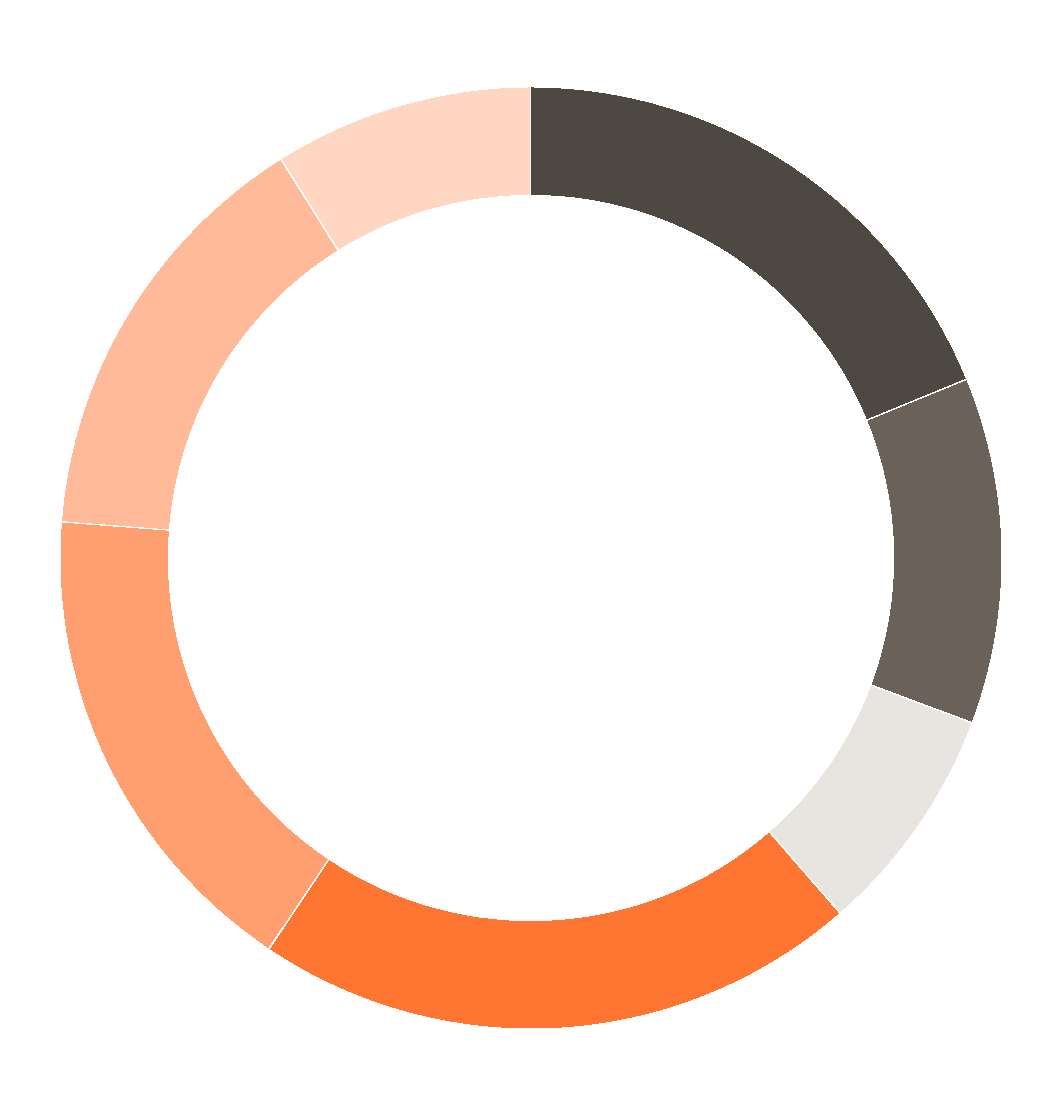
Revenues by Segment
and End Market

~40% Test & Measurement | |||||
 | 19% Diversified Electronics1 |  | 8% Semiconductor | ||
 | 12% Communications | ||||
 | 21% Industrial Manufacturing |  | 17% Defense & Space | ||
 | 15% Utilities |  | 9% Other2 | ||

Ralliant
Portfolio

~60% Sensors & Safety Systems |

(1)Diversified Electronics includes Industrial, Consumer, Automotive, Medical, Education,
and General Purpose.
(2)Other includes Food and Beverage, Healthcare, and HVAC.
Note: Percentages may not foot due to rounding.
By the
Numbers
~$2.1B Revenue | ||
~7K Team Members | ||
~20 Manufacturing Sites | ||
~90K Customers | ||
~2.2K Active Patents | ||
6 | | |||
Proxy Summary
This summary highlights information contained elsewhere in this Proxy Statement. This summary does not contain all of the
information that you should consider, and you should read the entire Proxy Statement carefully before voting. References to
“Ralliant,” the “Company,” “we,” “us,” “our,” and similar terms refer to Ralliant Corporation.
PROPOSAL 1 | |
Election of Class I Directors for a Three-Year Term | |
Board of Directors
Name and Principal Occupation | Age | Director Since | Committee Membership | ||||||
Independent | AC | CC | NGC | ||||||
Nominees for Election | Class I | ||||||||
Luis Müller President and Chief Executive Officer, Cohu, Inc. |  | 56 | 2025 |  | | ||||
Anelise Sacks Former Executive Vice President and Chief Customer Officer, Analog Devices, Inc. |  | 47 | 2025 | | |||||
Neil Schrimsher* President and Chief Executive Officer, Applied Industrial Technologies, Inc. | | 61 | 2025 | | | ||||
Continuing Directors | Class II | ||||||||
Kevin Bryant* Executive Vice President of External Affairs and Chief Strategy Officer, Southwest Power Pool | | 51 | 2025 | | | ||||
Kate Mitchell* Partner and Co-Founder, Scale Venture Partners | | 67 | 2025 | |  | ||||
Brian Worrell* Former Chief Financial Officer, Baker Hughes Company | | 56 | 2025 | | |||||
Class III | |||||||||
Ganesh Moorthy, Independent Board Chair Former President and Chief Executive Officer, Microchip Technology Incorporated | | 66 | 2025 | | | ||||
Tamara (Tami) Newcombe President and Chief Executive Officer, Ralliant Corporation | 60 | 2025 | |||||||
Alan Spoon Former Managing General Partner, Polaris Partners and Former President, The Washington Post | | 74 | 2025 | | |||||

AC | Audit Committee | CC | Compensation Committee | | Member |
NGC | Nominating and Governance Committee | * | Audit Committee Financial Expert | | Chair |
2026 Proxy Statement | 7 | |||
PROXY SUMMARY |
Board Snapshot
89% 8 out of 9 Directors are Independent | 33% 3 out of 9 Directors are Women | 44% 4 out of 9 Directors are Racially/Ethnically Diverse | 59.8 Years Average Director Age | |||
Skills and Experience
 | CEO Experience | ||
 | 5 / 9 | ||
 | CFO/Financial Expertise | ||
 | 4 / 9 | ||
 | P&L/Operating Leadership | ||
 | 7 / 9 | ||
 | Technology/Innovation | ||
| 7 / 9 | ||
 | Market-Driven Growth | ||
| 7 / 9 |
 | Relevant Industry Experience (semiconductor, utilities, test & measurement, defense) | ||
| 7 / 9 | ||
 | Human Capital Management | ||
 | 9 / 9 | ||
 | Public Board Experience | ||
| 7 / 9 | ||
 | Global Experience | ||
 | 8 / 9 | ||
 | Capital Allocation Experience (M&A, VC, partnerships) | ||
| 9 / 9 | ||
Governance Highlights
Board Composition and Independence | Strong Board Practices | Stockholder Accountability | ||||
| Independent Board Chair |
| Eight of nine (89%) directors are independent |
| Significant breadth of diverse skills, experiences, and areas of expertise |
| 100% independent Board committees |
| Regular executive sessions of independent directors |
| Majority vote standard in uncontested elections with director resignation policy |
| Structure in place to declassify the Board at the 2029 Annual Meeting |
| Starting at the 2029 Annual Meeting, will grant ≥25% stockholders the right to call special meetings |
| Starting at the 2029 Annual Meeting, will remove the supermajority vote requirement to amend bylaws and certificate of incorporation |
| Single voting class |
| Active stockholder outreach and engagement |
| Annual Board and committee self-evaluations |
| Limits on outside board commitments |
| Robust stock ownership guidelines for non-employee directors (5x annual retainer) |
| Director orientation and education programs |
| Active Board oversight of strategy, cybersecurity, human capital management and succession planning, AI, and corporate responsibility matters |
8 | | |||
PROXY SUMMARY |
PROPOSAL 2 | |
Advisory Vote to Approve Ralliant’s Named Executive Officer Compensation in Fiscal 2025 | |
Ralliant’s compensation philosophy emphasizes alignment with our stockholders’ experience, with compensation outcomes
driven by performance across annual and long-term incentive programs. Our executive compensation program is designed to
attract, motivate, and retain the talented leaders who drive our success and deliver performance aligned with our strategic plan.
We reward innovation, profitable growth, strong working capital management, and collaboration—working together as one team
—while balancing Company and individual performance. Alignment with our stockholders is a top priority, and a significant
portion of our named executive officer compensation is directly tied to Company performance and stockholder value creation.
Compensation Highlights
What We Do | What We Don’t Do | ||||
 | No excise tax gross-ups |
| No employment agreements for executive officers |
| No “single-trigger” change-in-control benefits |
| No pledging or hedging of Company shares |
| No evergreen provision in stock incentive plan |
| No repricing of stock options without stockholder approval |
| No liberal share recycling under stock incentive plan |
| No defined benefit plans for executive officers |
| No delivery of dividends or dividend equivalents on unvested long-term incentive awards |
| Robust stockholder outreach |
| Align performance measures with business strategy |
| “Double-trigger” change-in-control benefits |
| Rigorous performance goal setting |
| Multi-year vesting requirements for long-term incentive awards |
| Robust clawback policy applicable to cash- and equity- based compensation of senior executives |
| Rigorous stock ownership requirements |
| Annual risk assessment |
| Engage an independent compensation consultant |
| Cap on annual and long-term incentive awards |
| Limited perquisites |
PROPOSAL 3 | |
Advisory Vote on the Frequency of Future Advisory Votes to Approve Ralliant’s Named Executive Officer Compensation | |
PROPOSAL 4 | |
Ratification of the Appointment of Ernst & Young LLP as Ralliant’s Independent Auditor for Fiscal 2026 | |
2026 Proxy Statement | 9 | |||

PROPOSAL 1
Election of Class I Directors for a
Three-Year Term
Proposal Summary
Based on the recommendation of the Nominating and Governance Committee, the Board of Directors (the “Board”) has
nominated the following three Class I directors to hold office until the 2029 Annual Meeting of Stockholders and until their
successors are duly elected and qualified:
 |  |  |
Luis Müller | Anelise Sacks | Neil Schrimsher |
All Class I director nominees are currently serving as directors. Each Class I director nominee has consented to be named in
this Proxy Statement and to serve as a director if elected. We have no reason to believe that any director nominee will be
unable to serve as a director. However, if any director nominee is unavailable for election, proxies may be voted for another
person nominated as a substitute by the Board, or the Board may reduce the number of directors on the Board. Unless
otherwise instructed, the persons named as proxies will vote all proxies received for the election of each of the director
nominees. Proxies cannot be voted for a greater number of individuals than the three nominees named in this Proposal 1.
 | The Board recommends a vote FOR the election of each of the foregoing Class I director nominees. | ||
10 | | |||
PROPOSAL 1: ELECTION OF CLASS I DIRECTORS FOR A THREE-YEAR TERM |
Classified Board and Phase-Out
The Board consists of nine directors. Each of the current directors serving on the Board joined the Board in June 2025, in
connection with Ralliant’s separation (the “Separation”) from Fortive Corporation (“Fortive”) and listing on the New York Stock
Exchange (the “NYSE”). As is common for newly spun-off companies, Ralliant currently has a classified board, comprising
three classes:
•Class I: Luis Müller, Anelise Sacks, and Neil Schrimsher, whose terms expire at the Annual Meeting;
•Class II: Kevin Bryant, Kate Mitchell, and Brian Worrell, whose terms expire at the 2027 Annual Meeting; and
•Class III: Ganesh Moorthy, Tami Newcombe, and Alan Spoon, whose terms expire at the 2028 Annual Meeting.
Under Ralliant’s Amended and Restated Certificate of Incorporation, Ralliant will conduct a phased declassification of the Board
to be completed in 2029 as depicted below, with 2026 being the only year that a class of directors will be elected for a three-
year term. Starting with the 2029 Annual Meeting, directors will be elected annually and for a term of office to expire at the next
annual meeting of stockholders, and our Board will thereafter no longer be divided into classes.
2026 | 2027 | 2028 | 2029 | ||||||
Three-year term |  | ||||||||
Class I directors being reelected in 2026 and serving until 2029 | |||||||||
Two-year term |  | ||||||||
Class II directors reelected in 2027 and serving until 2029 | |||||||||
One-year term |  | ||||||||
Class III directors reelected in 2028 and serving until 2029 | |||||||||
In addition, other provisions contained in Ralliant’s Amended and Restated Certificate of Incorporation and Amended and
Restated Bylaws (the “Bylaws,” and together, the “Organizational Documents”) that were adopted in connection with the
Separation will be phased out, or “sunset,” in 2029. Starting with the 2029 Annual Meeting, (1) stockholders owning ≥25% of
Ralliant’s outstanding common stock may call special meetings; (2) directors may be removed with or without cause; and (3) a
simple majority of stockholders may amend the Organizational Documents (in each case, subject to compliance with the other
requirements contained in the Organizational Documents).
2026 Proxy Statement | 11 | |||
Board Composition
Nomination Process
The Nominating and Governance Committee is responsible for identifying and recommending to the Board qualified candidates
for Board membership. In evaluating director candidates, the Nominating and Governance Committee considers a wide range
of factors, including the candidate’s skills, background, expertise, and commitments, the current composition of the Board, and
any perceived need for one or more particular areas of expertise. Additionally, the Committee regularly, and at least annually,
evaluates the composition of the Board to determine the current and future skills and experiences needed to effectively oversee
Ralliant and its strategic direction. The Board believes that its directors, taken as a whole, should embody a mix of skills,
knowledge, expertise, and experiences appropriate in light of the Board’s needs.
The Nominating and Governance Committee may consider director candidates from several sources including those
recommended by directors, a third-party search firm, or stockholders. In connection with the use of a third-party search firm to
identify potential director candidates, the Nominating and Governance Committee will instruct the search firm to include in its
initial list of candidates qualified candidates who reflect the Board’s desired range of skills, knowledge, expertise, and
experiences. Candidates proposed by stockholders are evaluated using the same criteria as for other candidates. A stockholder
who wishes to recommend a director candidate for consideration by the Nominating and Governance Committee should send
such recommendation in writing using the procedures described under the “Communicating with the Board” section of this
Proxy Statement.
Assessing Nominees and Board Composition
The Board and the Nominating and Governance Committee believe it is important that directors demonstrate the standards and
qualifications set out in the Company’s Corporate Governance Guidelines, including:
•Personal and professional integrity and character;
•Prominence and reputation in the candidate’s profession;
•Diversity of skills, knowledge, expertise, and experiences useful and appropriate to the effective oversight of
Ralliant’s business;
•The extent to which the interplay of the candidate’s skills, knowledge, expertise, and experiences with that of the other
directors will help build a Board that is effective in collectively meeting Ralliant’s strategic needs and serving the long-term
interests of the stockholders;
•The capacity and desire to represent the interests of the stockholders as a whole; and
•Ability to devote sufficient time to the affairs of Ralliant.
12 | | |||
BOARD COMPOSITION |
Director Independence
Our Corporate Governance Guidelines provide that the Board shall consist of a majority of directors who qualify as independent
under the listing standards of the NYSE. The Board assesses the independence of each director annually. In determining the
independence of its directors, the Board considered relevant transactions, relationships, and arrangements between each
director and the Company. The Board affirmatively determined that all of our directors other than our CEO, Ms. Newcombe, are
independent under the NYSE listing standards. The Board has also determined that all members of the Audit Committee, the
Compensation Committee, and the Nominating and Governance Committee are independent and satisfy applicable
committee-specific independence requirements.
Limits on Outside Board Commitments
The Board understands the significant time commitment involved with serving on the Board and its committees. The Nominating
and Governance Committee and the Board only nominate candidates who they believe are capable of devoting the necessary
time to successfully meet their duties, taking into account principal occupations, memberships on other boards, and
other responsibilities.
Our Corporate Governance Guidelines state that directors should not serve on more than three boards of public companies in
addition to the Board, provided that a director who serves as an executive officer of a public company should not serve on more
than one public company board in addition to the Board. In accordance with the NYSE’s disclosure requirement, no member of
the Audit Committee may serve on more than two other public company audit committees without first obtaining the prior
approval of the Board.
Directors should advise the Chair of the Board, the Chair of the Nominating and Governance Committee, and the Corporate
Secretary before accepting membership on, or an invitation to be nominated as a candidate for election to, another board of
directors or audit committee or any other significant committee assignment. In addition, directors are expected to offer to resign
from the Board if they experience a substantial change to their principal occupation, subject to further consideration by the
Nominating and Governance Committee.
The Nominating and Governance Committee annually reviews outside director time commitments, including any leadership
positions on another public company’s board of directors, to evaluate and confirm that all directors have demonstrated that they
have committed and expect to commit appropriate time to serve effectively on the Board and its committees. Based on their
current board commitments, all directors are expected to be in compliance with our Corporate Governance Guidelines
regarding other board memberships as of the Annual Meeting.
2026 Proxy Statement | 13 | |||
BOARD COMPOSITION |
Director Skills and Qualifications
The skills matrix below represents the key skills, backgrounds, and expertise that the Board has identified as particularly
valuable to the oversight of the Company and illustrates how current directors individually and collectively represent these key
competencies and backgrounds. The Board believes that its highly qualified directors possess strong, complementary areas of
expertise and skills to effectively oversee the execution of Ralliant’s strategy.
Kevin Bryant | Kate Mitchell | Ganesh Moorthy | Luis Müller | Tami Newcombe | Anelise Sacks | Neil Schrimsher | Alan Spoon | Brian Worrell | ||||
| CEO Experience Current or former public company CEO or president with a track record of leadership, setting strategy, and delivering results | | | | | | ||||||
| CFO/Financial Expertise Public company CFO or senior finance executive with a deep understanding of capital markets, tax, and financial strategy planning and analysis | | | | | |||||||
| P&L/Operating Leadership Direct ownership of a business unit or company’s profit and loss, responsible for financial performance and growth | | | | | | | | ||||
| Technology/Innovation Leadership and understanding of technology-driven product development, R&D, and digital transformation efforts as well as AI innovation and cybersecurity experience | | | | | | | | ||||
| Market-Driven Growth Experience in driving revenue and expansion by understanding customer needs, competitive dynamics, and market opportunities | | | | | | | | ||||
| Relevant Industry Experience (semiconductor, utilities, test & measurement, defense) Direct experience in one of our key industries, bringing knowledge and insights that drive growth | | | | | | | | ||||
| Human Capital Management Experience leading large-scale talent strategies, including leadership development, succession planning, and organizational capability and culture transformation | | | | | | | | | | ||
| Public Board Experience Current or former member of a public company board with a clear understanding of governance, fiduciary duty, and accountability to stockholders | | | | | | | | ||||
| Global Experience Firsthand experience in navigating different business cultures, regulatory environments, and workforce dynamics by leading global organizations with significant revenue, customer bases, and/or employees outside the U.S. | | | | | | | | | |||
| Capital Allocation Experience (M&A, VC, partnerships) Led or played a key role in M&A, venture investments, or strategic partnerships that created stockholder value | | | | | | | | | |
14 | | |||
BOARD COMPOSITION |
Director Biographies
Class I Director Nominees
 | |
Qualifications and Experience Dr. Müller is a seasoned executive with over 25 years of business and technical leadership experience in the semiconductor industry. As Chief Executive Officer of a global semiconductor test automation and equipment supplier, he has guided over 3,000 employees through variable market conditions to deliver on innovative business expansion initiatives and strategic acquisitions in the U.S., Germany, Switzerland, and Japan to create value for stockholders. He provides the Board with a strong understanding of transformative technologies, test and measurement, R&D, competitive market environments, and evolving customer needs. Dr. Müller also brings extensive public company executive and board experience with valuable perspectives in the areas of corporate governance, risk management, and finance. Dr. Müller holds a BSc and MSc in Mechanical Engineering from Universidade Federal Santa Catarina and a PhD in Mechanical Engineering from the Massachusetts Institute of Technology. He has also earned certificates from Carnegie Mellon University (Cybersecurity Oversight) and MIT Professional Education (AI). | |
Luis Müller Independent Director Since: 2025 Age: 56 Committees: Compensation, Nominating and Governance Skills: •CEO Experience •P&L/Operating Leadership •Technology/Innovation •Market-Driven Growth •Relevant Industry Experience •Human Capital Management •Public Board Experience •Global Experience •Capital Allocation Experience | |
Career Highlights Cohu, Inc. (NASDAQ: COHU) – a global leader in semiconductor equipment and services •President and Chief Executive Officer (since 2014) •President, Semiconductor Equipment Group (2011-2014) •Managing Director, Rasco GmbH (2009-2011) •Vice President, Delta Design High Speed Handling Group (2008-2009) •Director of Engineering, Delta Design (2005-2008) Teradyne, Inc. (NASDAQ: TER) (acquired Kinetrix in 1999) – an advanced test and automation solutions company •Various management positions in engineering and business development (1999-2005) Kinetrix Semiconductor – a semiconductor equipment company •Co-Founder and Head of Engineering (1996-1999) Other Current Public Company Directorships •Cohu, Inc (NASDAQ: COHU) (2014-Present) Past Public Company Boards (Last Five Years) •Celestica Inc. (NYSE: CLS) (2021-2026) | |
2026 Proxy Statement | 15 | |||
BOARD COMPOSITION |
 | |
Qualifications and Experience Ms. Sacks has a proven track record of driving growth and innovation, demonstrated through her leadership in developing and executing customer strategies that bring cutting-edge technology solutions to market. In prior executive roles at global semiconductor companies, she contributed to stockholder value creation through P&L leadership driving growth and profitability. Having led product development teams in China, Japan, India, Germany, and the U.S., Ms. Sacks brings a deep technical background and has contributed to advancing AI, signal chain, power, sensing, micro-electromechanical systems (“MEMS”), and software technologies across multiple industries. She also brings experience in M&A, including post- merger integration and synergy realization. Ms. Sacks holds an Electrical and Electronic Engineering degree from the Federal University of Rio de Janeiro and an MBA from The Open University in the U.K. Ms. Sacks has also served as a senior advisor at Boston Consulting Group, Inc. since April 2025, and as Executive Chair and Co-Founder of Simplex Micro, a microprocessor and vector processor technology company, since September 2025. | |
Anelise Sacks Independent Director Since: 2025 Age: 47 Committees: Audit Skills: •P&L/Operating Leadership •Technology/Innovation •Market-Driven Growth •Relevant Industry Experience •Human Capital Management •Global Experience •Capital Allocation Experience | |
Career Highlights Analog Devices, Inc. (NASDAQ: ADI) – a global semiconductor company •Executive Vice President and Chief Customer Officer (2021-2025) Texas Instruments Inc. (NASDAQ: TXN) – a global multinational semiconductor company •General management roles with P&L responsibility, including Vice President and General Manager (2011-2021) •Customer-facing roles in Munich, Germany, including Key Account Manager (2005-2010) Robert Bosch GmbH – a multinational engineering and technology company •Various technical positions, including R&D Engineer in Brazil and Germany (2003-2005) | |
16 | | |||
BOARD COMPOSITION |
 | |
Qualifications and Experience Mr. Schrimsher brings extensive senior executive experience in the global industrial technology distribution and manufacturing space. As Chief Executive Officer of a leading industrial distribution business for over a decade, he has a strong track record of leading domestic and international growth initiatives, driving continuous operational improvements, and executing M&A. Mr. Schrimsher is also an experienced people leader and brings to the Board insights on talent development topics and human capital management. Mr. Schrimsher provides the Board with valuable perspectives on strategic planning and customer needs amidst a variable macroeconomic landscape, as well as expertise in innovative technologies, P&L management, and successful, industry-relevant growth strategies. He holds a B.S. in Business Administration from the University of Tennessee and an MBA from John Carroll University. | |
Neil Schrimsher Independent Director Since: 2025 Age: 61 Committees: Audit, Compensation Skills: •CEO Experience •P&L/Operating Leadership •Technology/Innovation •Market-Driven Growth •Relevant Industry Experience •Human Capital Management •Public Board Experience •Global Experience •Capital Allocation Experience | |
Career Highlights Applied Industrial Technologies, Inc. (NYSE: AIT) – an industrial supply distributor •President and Chief Executive Officer (since 2013) •Chief Executive Officer (since 2011) Cooper Industries plc (formerly NYSE: CBE) – a global electrical products manufacturer •Executive Vice President leading multiple businesses in the Electrical Products Group (2010-2011) •President, Cooper Lighting (2006-2010) Siemens AG (OTCMKTS: SIEGY) – a global electronics and electrical engineering company •Various leadership roles at Siemens Energy and Automation, including Vice President, Power Distribution and Controls and Vice President, Residential Infrastructure Division (2001-2006) General Electric Company (NYSE: GE) – an industrial conglomerate •Positions of increasing responsibility at GE Lighting (1984-2001) Other Current Public Company Directorships •Applied Industrial Technologies, Inc. (NYSE: AIT) (2011-Present) Past Public Company Boards (Last Five Years) •Patterson Companies, Inc (formerly NASDAQ: PDCO) (2014-2025) | |
2026 Proxy Statement | 17 | |||
BOARD COMPOSITION |
Class II Directors
 | |
Qualifications and Experience Mr. Bryant brings over 25 years of leadership in financial and strategic planning in the utilities and energy sector, with a track record of developing sustainable growth strategies. During his more than 20-year tenure at Evergy, Inc. and its legacy businesses, Mr. Bryant led complex utility operations, including transmission, distribution, resource planning, company integrations, and employee safety and training initiatives. He was also responsible for numerous financial teams and oversaw capital raising, M&A, investor relations, and financial reporting. His successful leadership in investor relations, operations, and financial strategy for public energy companies focused on delivering critical products and services for customers provides valuable perspectives for the Board’s oversight of Ralliant’s growth strategy and stockholder value creation. He holds a BSBA in Finance and Real Estate from the University of Missouri-Columbia and an MBA from Stanford University Graduate School of Business. | |
Kevin Bryant Independent Director Since: 2025 Age: 51 Committees: Audit, Nominating and Governance Skills: •CFO/Financial Expertise •P&L/Operating Leadership •Market-Driven Growth •Relevant Industry Experience •Human Capital Management •Public Board Experience •Capital Allocation Experience | |
Career Highlights Southwest Power Pool – an American power supplier and transmission organization •Executive Vice President of External Affairs and Chief Strategy Officer (since 2025) Evergy, Inc. (NASDAQ: EVRG) – an electric utility company •Executive Vice President and Chief Operating Officer (2018-2024) Great Plains Energy Incorporated (formerly NYSE: GXP) – an electric provider that merged with Westar Energy, Inc. to create Evergy in 2018 •Executive Vice President, Finance and Strategy and Chief Financial Officer (2015-2018) •Vice President, Strategic Planning and Risk Management (2014-2015) •Vice President, Investor Relations and Strategic Planning and Treasurer (2013-2014) •Vice President, Strategy and Risk Management (2011-2013) •Various other finance roles, including at Kansas City Power and Light (a subsidiary of Great Plains Energy) (2003-2011) Other Current Public Company Directorships •Winnebago Industries, Inc. (NYSE: WGO) (2021-Present) | |
18 | | |||
BOARD COMPOSITION |
 | |
Qualifications and Experience Ms. Mitchell brings to the Board over 40 years of experience in the technology industry, with a focus on building and investing in high-growth innovative software companies. As a well-known thought leader in the entrepreneurship and innovation space, Ms. Mitchell has actively worked on policy matters to increase access to public markets for emerging growth companies. Through her venture capital leadership, Ms. Mitchell brings valuable perspectives on capital allocation and capital markets. Ms. Mitchell contributes expertise in digital transformation through technology cycles, including the current wave driven by AI. Through her service on public company boards, she also brings to the Board her knowledge in corporate governance, finance, business management, cybersecurity, and executive compensation. She served as a board member of the National Venture Capital Association (NVCA), a venture capital trade association that advocates for policies supporting innovation and investment, from 2007 to 2016, including as Chair from 2010 to 2011. Ms. Mitchell holds a B.A. in Political Science from Stanford University as well as an MBA from Golden Gate University. She has also attended executive programs at Harvard Business School (Strategic Marketing) and MIT CSAIL/Sloan (AI). | |
Kate Mitchell Independent Director Since: 2025 Age: 67 Committees: Audit, Compensation (Chair) Skills: •CFO/Financial Expertise •Technology/Innovation •Human Capital Management •Public Board Experience •Global Experience •Capital Allocation Experience | |
Career Highlights Scale Venture Partners – a Silicon Valley-based firm that invests in early-stage technology companies •Partner and Co-Founder (since 1997) Bank of America Corporation (NYSE: BAC) – a multinational financial services company •Various senior leadership roles, including Senior Vice President for Bank of America Online Banking (1988-1996) Other Current Public Company Directorships •Fortive Corporation (NYSE: FTV) (2016-Present) Past Public Company Boards (Last Five Years) •SVB Financial Group (NASDAQ: SIVBQ) (2010-2024) | |
2026 Proxy Statement | 19 | |||
BOARD COMPOSITION |
 | |
Qualifications and Experience Mr. Worrell brings over 30 years of experience as a senior financial executive, with deep expertise in strategy, M&A, capital allocation, and financial reporting. As former Chief Financial Officer of a large public energy company and in finance leadership roles at a public diversified technology conglomerate, he has successfully led large teams, navigated global financial markets, and directed investment strategies to drive stockholder value. Mr. Worrell drove a $32 billion merger integration of General Electric’s petroleum operations with Baker Hughes, which created one of the leading players in the oil & gas industry by bringing together oilfield services and equipment, offerings, and technologies to deliver value for customers and investors. With a track record of managing complex corporate transactions, Mr. Worrell brings deep expertise in risk management, financial reporting integrity, and governance of corporate and financial risks. Mr. Worrell holds a B.A. in Economics from the University of North Carolina at Chapel Hill. | |
Brian Worrell Independent Director Since: 2025 Age: 56 Committees: Audit (Chair) Skills: •CFO/Financial Expertise •Relevant Industry Experience •Human Capital Management •Public Board Experience •Global Experience •Capital Allocation Experience | |
Career Highlights Baker Hughes Company (NASDAQ: BKR) – an energy technology company •Advisor (2022-2023) •Chief Financial Officer (2017-2022) General Electric Company (NYSE: GE) – an industrial conglomerate •Vice President and Chief Financial Officer, GE Oil and Gas Segment (2014-2017) •Vice President, Corporate Financial Planning and Analysis (2011-2014) •Vice President, Corporate Audit (2006-2010) •Chief Financial Officer, GE Oil and Gas (2003-2006) •Various financial leadership roles at GE Healthcare (1997-2002) Other Current Public Company Directorships •Solstice Advanced Materials Inc. (NASDAQ: SOLS) (2025-Present) | |
20 | | |||
BOARD COMPOSITION |
Class III Directors
 | |
Qualifications and Experience Mr. Moorthy is an accomplished senior executive with over four decades of experience in the semiconductor and technology industries. In his prior Chief Executive Officer and other C-suite roles, he steered companies through significant market shifts and oversaw several transformative acquisitions and restructuring efforts. He has a proven track record of leading innovation-focused strategies to unlock operational efficiencies and identify new and high-growth profitable revenue opportunities. Mr. Moorthy also brings to the Board significant public company board service and expertise in human capital management and capital allocation. In addition, he contributes deep marketing experience and insight into high-technology industry trends through his background in global manufacturing, operations, and R&D. He holds a B.S. in Physics from the University of Bombay, a B.S. in Electrical Engineering from the University of Washington, and an MBA in Marketing from National University. | |
Ganesh Moorthy Independent Board Chair Independent Director Since: 2025 Age: 66 Committees: Compensation, Nominating and Governance Skills: •CEO Experience •P&L/Operating Leadership •Technology/Innovation •Market-Driven Growth •Relevant Industry Experience •Human Capital Management •Public Board Experience •Global Experience •Capital Allocation Experience | |
Career Highlights Microchip Technology Incorporated (NASDAQ: MCHP) – a semiconductor company •President and Chief Executive Officer (2021-2024) •President and Chief Operating Officer (2016-2021) •Chief Operating Officer (2009-2016) •Various leadership roles (2001-2009) Cybercilium – a business intelligence solutions company •Chair, Chief Executive Officer and Co-Founder (2000-2001) Intel Corporation (NASDAQ: INTC) – a multinational technology company •Various senior leadership roles (1981-2000) Other Current Public Company Directorships •Celanese Corporation (NYSE: CE) (2023-Present) •GlobalFoundries Inc. (NASDAQ: GFS) (2026-Present) •SiTime Corporation (NASDAQ: SITM) (2025-Present) Past Public Company Boards (Last Five Years) •Microchip Technology Incorporated (NASDAQ: MCHP) (2021-2024) •Rogers Corporation (NYSE: ROG) (2013-2024) | |
2026 Proxy Statement | 21 | |||
BOARD COMPOSITION |
| |
Qualifications and Experience Before her appointment as Chief Executive Officer of Ralliant, Ms. Newcombe served as President of the Precision Technologies segment and the Advanced Healthcare Solutions segment at Fortive, bringing deep institutional knowledge critical to unlocking Ralliant’s full growth potential. In those roles, she oversaw 11 operating companies, led a global workforce of 11,000 employees, and managed $3.5 billion in operations based on revenue. Ms. Newcombe brings extensive experience in leading large-scale operations and has a strong background in go-to-market strategy within the technology sector, having held a variety of executive sales roles at Fortune 500 companies. Known for her customer-centric mindset, she has been instrumental in shaping multi-year strategies to navigate market shifts, scale through channel partnerships and strategic acquisitions, and deliver customer value through technology adoption. Ms. Newcombe holds a B.S. in Electrical and Biomedical Engineering from Syracuse University and an MBA from Union College. | |
Tami Newcombe Director Since: 2025 Age: 60 Skills: •CEO Experience •P&L/Operating Leadership •Technology/Innovation •Market-Driven Growth •Relevant Industry Experience •Human Capital Management •Global Experience •Capital Allocation Experience | |
Career Highlights Ralliant Corporation (NYSE: RAL) – a global technology company with businesses that design, develop, manufacture, and service precision instruments and highly engineered products •President and Chief Executive Officer (since 2025) Fortive Corporation (NYSE: FTV) – a provider of essential technologies for connected workflow solutions across a range of end markets •President and Chief Executive Officer, Precision Technologies segment (2022-2025) and Advanced Healthcare Solutions segment (2023-2025) •Group President (May 2021-Dec. 2021) •President, Tektronix (a subsidiary of the Company) (2019-2021) •Commercial President, Tektronix (2017-2019) Cisco Systems, Inc. (NASDAQ: CSCO) – a technology company specializing in networking, security, collaboration and cloud services •Vice President, Sales (2009-2017) •Various sales leadership roles (1999-2009) Analog Devices, Inc. (NASDAQ: ADI) – a global semiconductor company •Global Client Executive (1995-1999) IBM (NYSE: IBM) – a multinational technology company •Various positions, including Hardware Design Engineer (1989-1995) | |
22 | | |||
BOARD COMPOSITION |
 | |
Qualifications and Experience Mr. Spoon is a seasoned executive and highly experienced corporate director. He brings to the Board deep expertise in business strategy, leadership, and strategic transactions. In his most recent role as partner of a venture capital firm, he has overseen a number of accretive transactions focused on high-value industrial solutions, disciplined capital allocation strategies, and technology-driven operational investments. Mr. Spoon’s public company and private equity experience provides him with deep insights into trends in the technology industry, acquisition strategy, market opportunities, and financing, each of which represents an area of key strategic opportunity for Ralliant. Mr. Spoon has significant experience in public policy and public affairs through his past leadership roles at The Washington Post Company. He also brings extensive corporate governance experience through his service as a director on numerous public company boards, including serving as Fortive’s Independent Board Chair from 2016 to January 2025. He holds a B.S. and M.S. from Massachusetts Institute of Technology, and a JD from Harvard Law School. | |
Alan Spoon Independent Director Since: 2025 Age: 74 Committees: Nominating and Governance (Chair) Skills: •CEO Experience •CFO/Financial Expertise •P&L/Operating Leadership •Technology/Innovation •Market-Driven Growth •Human Capital Management •Public Board Experience •Global Experience •Capital Allocation Experience | |
Career Highlights Polaris Partners – a company that invests in private technology and life science firms •Partner Emeritus (2015-2018) •Partner (2000-2018) •Managing General Partner (2000-2010) The Washington Post Company (now known as Graham Holdings Company (NYSE: GHC)) – one of the country’s largest, publicly traded education and media companies •President, The Washington Post Company (1993-2000) •Chief Operating Officer and Director (1991-2000) •President, Newsweek (1989-1991) Other Current Public Company Directorships •Danaher Corporation (NYSE: DHR) (1999-Present) •IAC Inc./InterActiveCorp (NASDAQ: IAC) (2003-Present) Past Public Company Boards (Last Five Years) •Fortive Corporation (NYSE: FTV) (2016-2025) •Match Group, Inc. (NASDAQ: MTCH) (2015-2025) •Cable One, Inc. (NYSE: CABO) (2015-2021) | |
2026 Proxy Statement | 23 | |||
Corporate Governance
Board Leadership Structure
Ralliant’s Board currently has an Independent Board Chair. This structure allows Mr. Moorthy, as Board Chair, to lead agenda
setting and oversight of the Company’s strategy at the Board level, while Ralliant’s CEO, Ms. Newcombe, leads the
development and execution of the strategy. The Board does not have a set policy on whether the positions of Chair and CEO
should always be separated as the Board believes the structure should be based upon the needs of the Board and Ralliant at
any given time. Maintaining this flexibility allows the Board to choose the leadership structure that will best serve the interests of
Ralliant and its stockholders.
As the Independent Chair of the Board, Mr. Moorthy leads the activities of the Board, including:
•Calling, and presiding over, all Board meetings;
•Together with the CEO and the Corporate Secretary, setting and approving the agenda for Board meetings;
•Calling, and presiding over, the executive sessions of the independent directors;
•Advising the CEO on strategic aspects of Ralliant’s business, including developments and decisions that are to be discussed
with, or would be of interest to, the Board; and
•Acting as a liaison, as necessary, between the independent directors and the management of the Company.
In the event that the Chair of the Board is not an independent director, the Corporate Governance Guidelines provide that the
independent directors, upon recommendation from the Nominating and Governance Committee, will select by majority vote an
independent director to serve as the Lead Independent Director with the authority to:
•Preside at all meetings of the Board at which the Chair is not present, including executive sessions;
•Call meetings of the independent directors;
•Act as a liaison, as necessary, between the independent directors and the CEO; and
•Advise with respect to the Board’s agenda.
24 | | |||
CORPORATE GOVERNANCE |
Board Committees
The Board has three standing committees: the Audit Committee, the Compensation Committee, and the Nominating and
Governance Committee. Each of these committees is chaired by and consists of only independent directors. The current
membership and key responsibilities of each committee are described below. Each committee reports regularly to the full Board
and operates under a written charter adopted by the Board, which can be found on the Investors section of our website,
https://investors.ralliant.com, under “Governance.”
 | |||
Audit Committee Number of Meetings in 2025 (After Separation from Fortive): Two Key Responsibilities: The Audit Committee has the responsibilities set forth in its charter. These responsibilities include: •Overseeing Ralliant’s independent auditor, including the sole authority to appoint, retain, compensate, and evaluate the independent auditor; •Pre-approving all auditing services and permitted non-audit services to be performed by the independent auditor; •Overseeing Ralliant’s internal audit function; •Reviewing and discussing with management and the independent auditor the annual and quarterly financial statements and earnings press releases; •Reviewing and discussing management’s conclusions on the effectiveness of Ralliant’s (i) internal control over financial reporting and (ii) disclosure controls and procedures; •Overseeing swap and derivative transactions and related policies; •Overseeing Ralliant’s compliance program with respect to legal and regulatory requirements, including Ralliant’s Code of Conduct and policies and procedures for monitoring compliance; •Reviewing with management Ralliant’s risk assessment and risk management policies, including major financial, privacy, cybersecurity, and business continuity risk exposures and the steps management has taken to monitor and mitigate such exposures; and •Preparing a report as required by the SEC to be included in this Proxy Statement. | |||
Chair: Brian Worrell | |||
Other Members: | |||
 | Kevin Bryant | ||
 | Kate Mitchell | ||
 | Anelise Sacks | ||
| Neil Schrimsher | ||
The Board has determined that each member of the Audit Committee is (i) independent for purposes of Rule 10A-3(b)(1) under the Securities Exchange Act of 1934, as amended (the “Exchange Act”) and the NYSE listing standards and (ii) financially literate within the meaning of the NYSE listing standards. In addition, the Board has determined that Messrs. Worrell, Bryant, and Schrimsher and Ms. Mitchell each qualifies as an “audit committee financial expert” for purposes of SEC rules. | |||
2026 Proxy Statement | 25 | |||
CORPORATE GOVERNANCE |
 | |||
Compensation Committee Number of Meetings in 2025 (After Separation from Fortive): Three Key Responsibilities: The Compensation Committee has the responsibilities set forth in its charter. These responsibilities include: •Determining and approving the form and amount of annual compensation of the CEO and our other executive officers, including evaluating the performance of, and approving the compensation paid to, our CEO and other executive officers; •Reviewing and making recommendations to the Board with respect to the adoption, amendment, and termination of all executive incentive compensation plans and all equity compensation plans, and exercising all authority with respect to the administration of such plans; •Reviewing and making recommendations to the Board with respect to the form and amounts of director compensation; •Overseeing and monitoring compliance with Ralliant’s compensation clawback policy; •Monitoring compliance by directors and executive officers with Ralliant’s stock ownership requirements; •Overseeing risks associated with Ralliant’s compensation policies and practices; •Assisting the Board in oversight of Ralliant’s human capital management practices; and •Reviewing and discussing with management the Compensation Discussion and Analysis in the annual proxy statement and recommending to the Board its inclusion in the proxy statement. | |||
Chair: Kate Mitchell | |||
Other Members: | |||
 | Ganesh Moorthy | ||
 | Luis Müller | ||
| Neil Schrimsher | ||
The Board has determined that (i) each member of the Compensation Committee is independent for purposes of Rule 10C-1 under the Exchange Act and under the NYSE listing standards and (ii) Ms. Mitchell and Messrs. Moorthy and Müller are each a “non-employee director” for purposes of Rule 16b-3 under the Exchange Act. | |||
26 | | |||
CORPORATE GOVERNANCE |
 | |||
Nominating and Governance Committee Number of Meetings in 2025 (After Separation from Fortive): Two Key Responsibilities: The Nominating and Governance Committee has the responsibilities set forth in its charter. These responsibilities include: •Reviewing and making recommendations to the Board regarding the size, classification, and composition of the Board; •Assisting the Board in identifying individuals qualified to become Board members; •Assisting the Board in identifying characteristics, skills, and experiences for the Board with the objective of having a Board with a diverse range of skills, knowledge, expertise, and experiences; •Proposing to the Board the director nominees for election by stockholders at each annual meeting; •Assisting the Board in determining the independence and qualifications of the Board and committee members and making recommendations to the Board regarding committee membership; •Developing and making recommendations to the Board regarding Ralliant’s Corporate Governance Guidelines and reviewing such guidelines on an annual basis; •Overseeing Ralliant’s engagement with stockholders and proxy advisory firms on corporate governance matters; •Overseeing and reviewing the process for, and making recommendations to the Board relating to the management of, the Company’s CEO succession planning; •Assisting the Board in overseeing Ralliant’s corporate responsibility matters, including sustainable business practices and strategies; •Assisting the Board and the Board committees in an annual self-evaluation process; •Overseeing the education and orientation program for newly elected members of the Board and continuing director education; and •Administering Ralliant’s Related Person Transactions Policy. | |||
Chair: Alan Spoon | |||
Other Members: | |||
| Kevin Bryant | ||
| Ganesh Moorthy | ||
| Luis Müller | ||
The Board has determined that each member of the Nominating and Governance Committee is independent within the meaning of the NYSE listing standards. | |||
2026 Proxy Statement | 27 | |||
CORPORATE GOVERNANCE |
Meeting Attendance and Executive Sessions
Directors are expected to attend all meetings of the Board, meetings of the committees on which they serve, and the Annual
Meeting of Stockholders. The Board held two meetings in 2025 (from the date of the Separation in June 2025 through the end
of the fiscal year). Each director attended at least 75% of the total number of 2025 meetings of the Board and of each
Committee on which he or she served.
The independent directors meet in executive session at each of the regularly scheduled Board meetings and as necessary at
other Board meetings. The Board’s Independent Chair presides over these executive sessions.
Annual Board and Committee Self-Evaluations
The Board recognizes that a robust and constructive evaluation process is a key component of Board effectiveness. The
Nominating and Governance Committee is responsible for overseeing the annual self-evaluation process of the Board and its
committees. Given that the Board only began serving in the third quarter of 2025, the Nominating and Governance Committee
recommended a process that enabled reflection on the Board’s initial year of service, which included a questionnaire completed
by each director focused on Board and committee composition and dynamics, culture, and the functioning and performance of
the Board thus far. The Chair of the Nominating and Governance Committee reviewed the results of the evaluation in executive
session with the full Board.
Going forward, the Nominating and Governance Committee has recommended a robust annual process designed to facilitate a
candid assessment and elicit actionable feedback and areas for improvement, as outlined below, and will determine the most
appropriate evaluation process each year depending on the needs and circumstances of the Board and its committees.
Planning and Process Design | Written Questionnaire | Representative Topics Expected to be Covered | Discussion and Feedback |
•Nominating and Governance Committee reviews the format and process of the annual evaluations, including topics to be addressed | •Each director completes detailed questionnaires •Questionnaires provide space for and encourage candid commentary | •Board composition and leadership structure •Frequency and format of meetings •Board culture •Board performance and effectiveness •Board responsibilities •Director access to management •Relevant business topics of interest •Committee structure and responsibilities | •Anonymized results provided to the Independent Board Chair and respective committee chairs with all comments provided verbatim •Review and discussion in executive sessions of Board and committee meetings •Individual discussions between Independent Board Chair and each director |
28 | | |||
CORPORATE GOVERNANCE |
Director Orientation and Education
Our Nominating and Governance Committee oversees and reviews the orientation program for new directors and the
continuing director education program.
Director Orientation
Before the Separation, members of Ralliant’s senior management team held two in-person immersion sessions for the incoming
directors. The sessions were designed to educate and familiarize the directors with Ralliant’s business, strategies, and policies
and assist the directors in developing Ralliant and industry knowledge in order to optimize their service on the Board following
the Separation in June 2025.
The Board prioritizes robust director orientation and onboarding programs to help new directors become integrated into
boardroom discussions and maximize their contributions. Ralliant has designed a comprehensive onboarding program for new
directors covering key functional areas of our business, introducing the importance of the Ralliant Business System (“RBS”),
and familiarizing them with the Board and its committees. After joining the Board, each new director is expected to receive
personal briefings by senior management on our business, strategic plans, financial statements, and key policies and practices.
Director Education
Ralliant provides continuing education to directors through internal and external opportunities, including through educational
sessions at Board meetings, site visits, briefings on topics identified or requested by management or the Board, and additional
opportunities to interact with members of management and other employees. In 2025, the Board hosted a meeting at an
operating company campus so directors could witness firsthand RBS in action and hear from emerging operating company
leaders on new product introductions. Additionally, management invited an outside expert to present on the Board ‘s role in AI
oversight at a Board meeting in 2025. The Board also encourages directors to participate in
third-party programming.
Key Areas of Board Oversight

Strategy
The Board has oversight responsibility for management’s establishment and execution of corporate strategy. The Board
formally reviews Ralliant’s corporate strategy annually and elements of our strategy are regularly discussed as a matter of
course at Board meetings. The Board also engages directly with senior management and leaders of Ralliant’s operating
companies, in and outside of Board meetings, to review strategic and operational priorities, the competitive environment,
market challenges, economic trends, and regulatory developments. In Ralliant’s first year as a standalone company, the Board
has been actively engaged in overseeing and guiding the development of our multi-year strategic plan at both the enterprise
and operating company levels. The Board also regularly reviews and provides insights on Ralliant’s capital allocation priorities
and strategy.
2026 Proxy Statement | 29 | |||
CORPORATE GOVERNANCE |
Risk
The Board oversees risk at Ralliant, with a focus on the most significant risks facing Ralliant, including those that relate to
strategic, operational, financial, legal and compliance, and reputational matters. The Board has also delegated specific risk
responsibility to its three committees, the members of which are all independent directors. Management is responsible for
managing risk. A summary of the allocation of risk oversight functions among the Board, its committees, and management is
as follows:
Full Board | ||
Oversees risks associated with Ralliant’s strategic plan, capital allocation priorities, capital structure, liquidity, organizational structure, and other significant risks. | ||
Audit Committee | Compensation Committee | Nominating and Governance Committee |
Oversees Ralliant’s risk assessment and risk management policies and specific risks related to financial controls, legal and compliance risks, and major financial, privacy, cybersecurity, and business continuity matters. | Oversees risks associated with compensation policies and practices and human capital management. | Oversees risks related to corporate governance, Board and committee structure, CEO succession planning, and corporate responsibility matters. |
Management | ||
Responsible for the identification, assessment, and management of risks. In support of these responsibilities, Ralliant maintains a Risk Committee, co-chaired by the Senior Vice President – Chief Legal and Government Affairs Officer and Senior Vice President – Chief Financial Officer, and comprising senior leaders with broad enterprise experience. The Risk Committee inventories, assesses, and prioritizes the most significant risks facing Ralliant as well as related mitigation efforts. Ralliant expects management to at least annually provide the full Board with an overview of its enterprise risk management program. | ||
Human Capital Management and Succession Planning
The Board has delegated to the Compensation Committee the responsibility of overseeing Ralliant’s human capital
management practices. Our Senior Vice President – Chief People Officer provides reports to the Compensation Committee on
human capital management matters, including employee engagement, inclusion, talent development, and culture. The
Compensation Committee reports to the full Board following each of its regularly scheduled meetings. The Board also remains
actively involved, frequently discusses talent matters at its meetings, and receives at least an annual update on organizational
health from our Senior Vice President – Chief People Officer.
The full Board oversees senior management succession planning, with the responsibility of review and oversight of the process
for Ralliant’s CEO succession plan delegated to the Nominating and Governance Committee. In accordance with our Corporate
Governance Guidelines, at least annually, the Board reviews and concurs in a management succession plan to provide for
continuity in senior management addressing (i) emergency CEO succession, (ii) CEO succession in the ordinary course of
business, and (iii) succession of the other members of senior management. High-potential leaders are given exposure and
visibility to Board members through formal presentations and at informal events during Board meetings. This engagement gives
the Board insight into the Company’s talent pool and management succession plans.
30 | | |||
CORPORATE GOVERNANCE |
Cybersecurity
Oversight responsibility for cybersecurity risk is shared by the Board and the Audit Committee. The Board has delegated to the
Audit Committee primary responsibility of exercising oversight with respect to the Company’s cybersecurity risk management.
Ralliant’s Senior Vice President – Chief Technology and Growth Officer and our Chief Information Security Officer report to the
Audit Committee quarterly on cybersecurity matters, including threat landscape developments, metrics used to monitor the
effectiveness of the Company’s cybersecurity program, and third-party reviews and assessments. The Audit Committee reports
to the full Board on matters discussed during its meetings, and in 2026, we expect to provide the full Board an overview of
Ralliant’s cybersecurity program. The Company also has protocols by which certain cybersecurity incidents are escalated and,
where appropriate, reported to the Audit Committee in a timely manner.
For more information on our cybersecurity risk management, strategy, and governance, see “Item 1C. Cybersecurity” of our
Annual Report on Form 10-K for the fiscal year ended December 31, 2025.
Artificial Intelligence
Ralliant incorporates AI solutions, including generative AI, into the Company’s products, services, operations, and
developmental processes. Ralliant has established an AI Governance Committee, composed of leaders across a variety of
business, technology, and support functions, to oversee the creation and implementation of risk control and strategic
frameworks. The full Board oversees Ralliant’s strategy and risk management related to AI and receives periodic updates from
management on Ralliant’s AI initiatives and governance.
Corporate Responsibility
The Nominating and Governance Committee assists the Board in its oversight of Ralliant’s corporate responsibility matters,
including sustainable business practices and strategies. Operating responsibly and sustainably is a foundational aspect of RBS
and is embedded across Ralliant and its operating companies. RBS drives sustainability by aiming to improve efficiencies,
reduce waste, and foster continuous improvement in day-to-day operations. Additionally, Ralliant’s products and services
enable customers to be more sustainable in their own operations and help to create a more sustainable and resilient
infrastructure through precision technologies. For example, Qualitrol plays a key role in power grid modernization efforts by
providing essential electrical asset monitoring equipment, data, and analytics to utilities and power companies that reduce
unplanned outages, optimize asset performance and energy efficiency, and extend the operational life of critical
power infrastructure.
Following the Separation and with the oversight of the Nominating and Governance Committee, the management team is in the
process of developing a sustainability strategy for Ralliant, which includes seeking input from our stockholders, customers,
and employees.
2026 Proxy Statement | 31 | |||
CORPORATE GOVERNANCE |
Investor Engagement
The Board and management believe in transparent and open communication with investors. The Ralliant Investor Relations
team routinely engages in dialogue with stockholders and prospective stockholders on various topics, including business
strategy, financial performance, and capital allocation plans. Since May 2025, management has met with stockholders
representing over 70% of shares outstanding and presented at seven conferences to help investors gain better insight into our
growth strategy and financial performance.
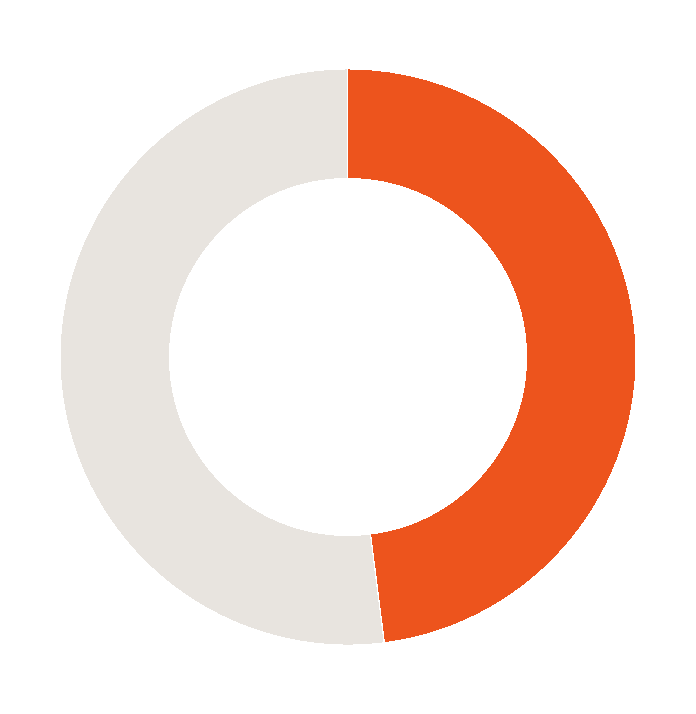
In addition to these ongoing meetings, in early 2026, Ralliant conducted an inaugural round of investor engagement focused
primarily on governance topics. As part of this engagement effort, Ralliant contacted stockholders representing approximately
48% of our outstanding shares at the time of outreach, and members of management met with stockholders representing
approximately 42% of outstanding shares. In these conversations, management discussed a variety of topics, including
corporate governance, executive compensation, corporate responsibility, and other strategic matters. Ralliant looks forward to
continuing this dialogue.
Inaugural Governance Engagement
Outreach and Engagement | Feedback | |||
Investors provided valuable comments and perspectives, and Ralliant’s practice is to share this feedback with the Board’s Nominating and Governance Committee and other relevant committees, as appropriate, who also provide updates to the full Board | ||||
Contacted | Engaged | |||
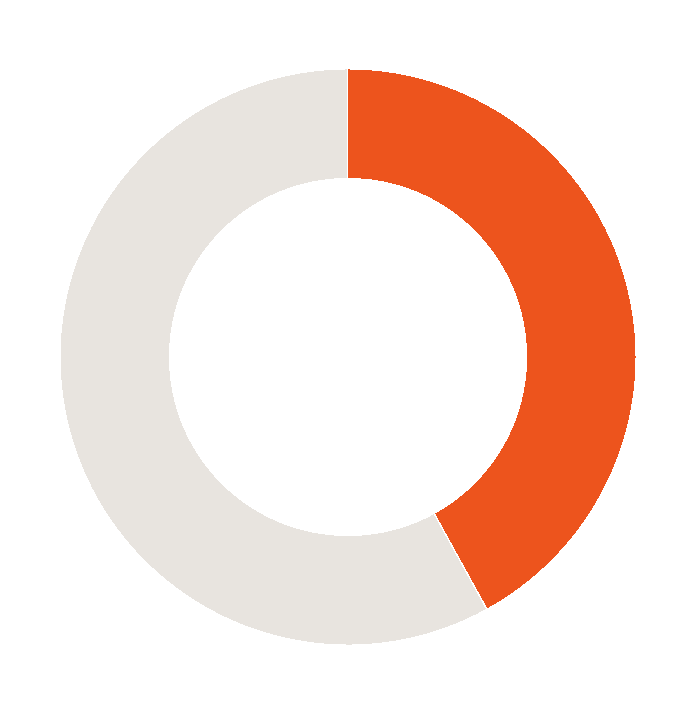
~48% of outstanding shares* | ~42% of outstanding shares* | |||
* At time of outreach | ||||
Topics Discussed | ||||
Board and Corporate Governance •Board composition and director skills •Board leadership structure •Classified Board sunset •Other governance policies Executive Compensation •Guiding principles and philosophy of the Ralliant Compensation Committee •Compensation governance practices | Corporate Responsibility •RBS support of operational sustainability •Disclosure expectations Business and Strategy •Overview of Ralliant and business segments •Capital allocation strategy •RBS operating model and culture of continuous improvement | |||
32 | | |||
CORPORATE GOVERNANCE |
Other Governance Matters
Corporate Governance Guidelines and Code of Conduct
The Board has adopted a set of Corporate Governance Guidelines, which include guidelines and standards with respect to the
role and composition of the Board, the functioning of the Board and its committees, director orientation and continuing
education, Board and committee self-evaluations, access to management and independent advisors, and other matters. The
Nominating and Governance Committee regularly reviews and assesses corporate governance developments and
recommends to the Board modifications to the Corporate Governance Guidelines as appropriate. The Board has also adopted
our Code of Conduct that includes, among other things, a code of business conduct and ethics for directors, officers, and
employees. The Corporate Governance Guidelines and the Code of Conduct are each available on the Investors section of
Ralliant’s website, https://investors.ralliant.com, under “Governance.”
Communicating with the Board
Stockholders and other interested parties may communicate with the Board, individual directors, the non-management directors
as a group, or with the Chair of the Board by mailing correspondence to the attention of the Board of Directors of Ralliant
Corporation, c/o Chief Legal and Government Affairs Officer and Corporate Secretary, 4114 Center at North Hills Street, Suite
400, Raleigh, North Carolina 27609. The Corporate Secretary or Assistant Corporate Secretary reviews and forwards
communications to the directors as appropriate. We will generally not forward a communication that is primarily commercial in
nature, is improper, profane or offensive, or is a request for general information about Ralliant.
Certain Legal Proceedings
SEC rules require us to describe certain legal proceedings involving any of our directors, director nominees, or executive
officers that occurred within the past 10 years. Prior to joining Ralliant as Senior Vice President – Chief Financial Officer in June
2025, Neill Reynolds had served as the Executive Vice President and Chief Financial Officer of Wolfspeed, Inc. (“Wolfspeed”)
from August 2018 through May 2025. Following Mr. Reynolds’s departure, on June 30, 2025, Wolfspeed filed voluntary petitions
under Chapter 11 of the U.S. Bankruptcy Code in federal bankruptcy court to implement a prepackaged Chapter 11 plan of
reorganization. On September 29, 2025, Wolfspeed announced the completion of its financial restructuring process and
emergence from Chapter 11 protection.
2026 Proxy Statement | 33 | |||
Certain Relationships and Related
Person Transactions
Policy and Procedures
The Board has adopted a written Related Person Transactions Policy (the “RPT Policy”) setting forth the policies and
procedures for the review and approval of transactions in which related persons have a direct or indirect material interest that
are required to be reported under SEC rules. Related persons include directors and executive officers as well as greater than
5% stockholders of the Company and members of their immediate families.
To help identify related person transactions and relationships, each director and executive officer completes a questionnaire
that requires the disclosure of any transaction or relationship that the person, or any member of his or her immediate family,
has or is proposed to have with Ralliant. The Company’s Chief Legal and Government Affairs Officer is primarily responsible for
the development and implementation of processes and controls to obtain information from the directors and executive officers
about any such transactions. The Chief Legal and Government Affairs Officer is also responsible for determining whether a
transaction or relationship constitutes a related person transaction requiring compliance with the RPT Policy.
Under the RPT Policy, the Nominating and Governance Committee is required to review all related person transactions prior to
consummation. If the Chief Legal and Government Affairs Officer becomes aware of a related person transaction that has not
been previously approved, the transaction is submitted to the Nominating and Governance Committee at its next meeting.
The Nominating and Governance Committee is required to review and consider all relevant information available to it about
each related person transaction, and a transaction is considered approved under the RPT Policy if the Nominating and
Governance Committee authorizes it according to the terms of the RPT Policy after full disclosure of the related person’s
interests in the transaction and other relevant facts. Related person transactions of an ongoing nature are required to be
reviewed annually by the Nominating and Governance Committee. The definition of “related person transactions” for purposes
of the RPT Policy covers the transactions that are required to be disclosed under Item 404(a) of Regulation S-K under the
Exchange Act.
Agreements with Fortive
On June 28, 2025, Ralliant completed the Separation from Fortive. In connection with the Separation, our subsidiaries that
currently operate our businesses and the corresponding assets and liabilities were transferred to Ralliant, which, prior to such
transfer, were held by Fortive. Prior to the Separation, Fortive owned 100% of the common shares of Ralliant. Following the
Separation, Fortive and Ralliant operate as separate publicly traded companies, and currently neither entity has any ownership
interest in the other.
In connection with the Separation, Fortive and Ralliant entered into a separation and distribution agreement as well as various
other related agreements that govern the Separation and the relationships between Fortive and Ralliant going forward,
including an employee matters agreement, a tax matters agreement, a transition services agreement, an intellectual property
matters agreement, a Fortive Business System (“FBS”) license agreement, and a Fort Solutions license agreement.
These agreements provide for the allocation of assets, employees, liabilities, and obligations (including investments, property,
employee benefits, and tax-related assets and liabilities) between Fortive and Ralliant attributable to periods prior to, at, and
after the Separation and govern certain relationships between Fortive and Ralliant after the Separation. Each of these
agreements is described further below.
Each of the agreements between us and Fortive and its subsidiaries that were entered into prior to the Separation, and any
transactions contemplated thereby, were deemed to be approved and not subject to the terms of the RPT Policy
described above.
34 | | |||
CERTAIN RELATIONSHIPS AND RELATED PERSON TRANSACTIONS |
Separation and Distribution Agreement
Ralliant entered into a separation and distribution agreement with Fortive immediately prior to the distribution of its common
stock to Fortive shareholders (the “Separation and Distribution Agreement”). The Separation and Distribution Agreement sets
forth the agreements with Fortive regarding the principal actions to be taken in connection with the Separation. It also sets forth
other agreements that govern certain aspects of Ralliant’s relationship with Fortive following the Separation.
Pursuant to the terms of the Separation and Distribution Agreement, Ralliant was subject to cash adjustment provisions, with
payment of such adjustments to be made within five business days of the determination of the applicable final cash balance.
Pursuant to the adjustment provisions, Ralliant’s aggregate cash balance at the time of the Separation, excluding any cash in
certain restricted jurisdictions, was determined to have been greater than the reference cash balance of $150 million, and
therefore, Ralliant was obligated to pay Fortive the excess. Subsequent to the Separation, Fortive notified Ralliant the
aggregate cash balance exceeded such reference cash balance by approximately $41 million, and Ralliant paid Fortive in
accordance with the terms of the Separation and Distribution Agreement in the year ended December 31, 2025.
Employee Matters Agreement
Ralliant and Fortive entered into an employee matters agreement that governs Ralliant’s and Fortive’s compensation and
employee benefit obligations with respect to the employees and other service providers of each company, and generally will
allocate liabilities and responsibilities relating to employment matters, employee compensation, and benefit plans and programs
(the “Employee Matters Agreement”).
The Employee Matters Agreement provided that each Fortive equity award held by Ralliant employees that was outstanding
immediately prior to the completion of the distribution would be assumed by Ralliant and converted into a Ralliant equity award
denominated in shares of Ralliant common stock with a comparable value, based on an equity award adjustment ratio to be
adopted by Fortive for purposes of making equitable adjustments to the Fortive equity awards held by Ralliant employees.
The Employee Matters Agreement provided that, following the completion of the distribution, Ralliant employees generally will
no longer participate in benefit plans sponsored or maintained by Fortive and will commence participation in Ralliant benefit
plans, which are generally similar to the existing Fortive benefit plans.
The Employee Matters Agreement also sets forth the general principles relating to employee matters, including with respect to
the assignment and transfer of employees, the assumption and retention of liabilities and related assets, workers’
compensation, payroll taxes, regulatory filings, leaves of absence, the provision of comparable benefits, employee service
credit, the sharing of employee information, and the duplication or acceleration of benefits.
Tax Matters Agreement
In connection with the Separation, Ralliant and Fortive entered into a tax matters agreement that governs the parties’ respective
rights, responsibilities, and obligations with respect to taxes, including responsibility for tax liabilities, entitlement to tax refunds
and other tax benefits, allocation of tax attributes, preparation and filing of tax returns, control of audits and other tax
proceedings, and other matters relating to taxes (the “Tax Matters Agreement”). In general, and subject to certain exceptions
(including with respect to certain transaction taxes triggered by the Separation), under the Tax Matters Agreement, Ralliant will
be responsible for any U.S. federal, state, local, or foreign taxes (and any related interest, penalties, or audit adjustments)
imposed with respect to tax returns that include only Ralliant and/or any of Ralliant’s subsidiaries. Ralliant will generally be
responsible for preparing and filing any such tax returns, and will generally have the authority to control tax contests with
respect thereto.
In addition, the Tax Matters Agreement imposes certain restrictions on Ralliant and its subsidiaries designed to preserve the
tax-free status of the distribution and certain related transactions, as well as the intended tax treatment of certain transactions
entered into pursuant to the internal restructuring. Ralliant (and its subsidiaries) will be barred from taking any action, or failing
to take any action, if such action or failure to act would adversely affect, or could reasonably be expected to adversely affect,
the tax-free status or other intended tax treatment of these transactions. In addition, for the two-year period following the
distribution, Ralliant (and its subsidiaries) will be subject to specific restrictions on its ability to enter into certain capital-raising,
strategic, or other corporate transactions, including restrictions on: (i) mergers and other acquisition or sale transactions
involving Ralliant’s stock, (ii) any corporate transaction which would cause Ralliant to undergo a 50% or greater change in its
stock ownership (as determined for purposes of Section 355(e) of the Internal Revenue Code of 1986, as amended (the
“Code”)), (iii) redemptions or repurchases of its stock, (iv) liquidation transactions, (v) discontinuing the active conduct of its
2026 Proxy Statement | 35 | |||
CERTAIN RELATIONSHIPS AND RELATED PERSON TRANSACTIONS |
trade or business, (vi) issuance or sale of its stock or other securities (including securities convertible into its stock, but
excluding certain compensatory arrangements), (vii) sales of assets outside of the ordinary course of business, and (viii)
amendments to its certificate of incorporation (or other organizational documents) or other actions affecting the voting rights of
Ralliant’s common stock.
The Tax Matters Agreement provides special rules that allocate tax liabilities in the event the distribution, together with certain
related transactions, as well as any transaction entered into pursuant to the internal reorganization that is intended to be
tax-free for applicable tax law purposes, is not tax-free (or otherwise fails to qualify for its intended tax treatment). In general,
under the Tax Matters Agreement, each party is expected to be responsible for any taxes, whether imposed on Ralliant or
Fortive, that arise from (1) the failure of the distribution, together with certain related transactions, to qualify for tax-free
treatment under the Code or (2) the failure of certain related transactions to qualify for their intended tax treatment, in each
case, to the extent that the failure to so qualify is attributable to post-distribution actions by such party or transactions with
respect to such party’s stock, or to a breach of certain representations or covenants made by that party in the Tax Matters
Agreement or in any documents relating to the Internal Revenue Service ruling or opinions of tax advisors obtained in
connection with the distribution, certain related transactions, or the internal restructuring.
Pursuant to the terms of the Tax Matters Agreement, Ralliant is required to reimburse Fortive or pay taxing authorities directly
for an amount contractually agreed with Fortive of approximately $51.0 million. Of the approximately $51.0 million of tax
transaction costs, $50.0 million was paid during 2025 and $1.1 million was accrued as a payable due to Fortive as of December
31, 2025. The total tax transaction costs of $51.0 million were recognized in the third quarter and were recorded as an offset to
additional paid-in capital as the items represent a settlement with Fortive in accordance with the Tax Matters Agreement.
Transition Services Agreement
Ralliant and Fortive have entered into a transition services agreement that became effective upon the distribution, pursuant to
which Fortive and its subsidiaries and Ralliant and its subsidiaries provide to each other, for an interim, transitional period,
various services in order to help ensure an orderly transition following the Separation and the distribution (the “Transition
Services Agreement”). The cost of these services is negotiated between Ralliant and Fortive as set forth in the Transition
Services Agreement.
The Transition Services Agreement terminates on the expiration of the term of the last service provided under it, unless earlier
terminated by either party under certain circumstances, including, but not limited to, in the event of any uncured material breach
by the other party or its applicable affiliates. If no term period is provided for a specified service, then such service is to
terminate on the second anniversary of the effective date of the Transition Services Agreement. The recipient of a particular
service generally can terminate that service prior to the scheduled expiration date, subject to a minimum notice period equal to
30 days.
Ralliant does not expect the net costs associated with the Transition Services Agreement to be materially different than the
historical costs that have been allocated to Ralliant related to these same services prior to the Separation.
Per the Transition Services Agreement, Fortive and Ralliant provide to each other certain specified services on a temporary
basis, including various information technology, financial, and administrative services. The costs of these services are
negotiated between Ralliant and Fortive as set forth in the Transition Services Agreement and were immaterial during the year
ended December 31, 2025.
Intellectual Property Matters Agreement
Ralliant and Fortive entered into an intellectual property matters agreement pursuant to which Fortive granted to Ralliant a
non-exclusive, royalty-free, fully paid-up, worldwide, irrevocable, sublicensable (subject to the restrictions below) license to use
certain intellectual property rights retained by Fortive (the “Intellectual Property Matters Agreement”). Ralliant will be able to
sublicense its rights in connection with activities relating to Ralliant and its affiliates’ business but not for independent use by
third parties.
Ralliant will also grant back to Fortive a non-exclusive, royalty-free, fully paid-up, worldwide, irrevocable, sublicensable (subject
to the restrictions below) license to continue to use certain intellectual property rights owned by or transferred to Ralliant.
Fortive will be able to sublicense its rights in connection with activities relating to Fortive’s and its affiliates’ retained business
but not for independent use by third parties. This license-back will permit Fortive to continue to use certain of Ralliant’s
36 | | |||
CERTAIN RELATIONSHIPS AND RELATED PERSON TRANSACTIONS |
intellectual property rights in the conduct of its remaining businesses. Ralliant believes that the license-back will have little
impact on its businesses because Fortive’s use of intellectual property rights is generally limited to products and services that
are not part of Ralliant’s businesses.
The Intellectual Property Matters Agreement is intended to provide freedom to operate in the event that any of Fortive’s retained
trade secrets (excluding FBS), copyrights, or patented technology is used in any of Ralliant’s businesses, and, as such, applies
to all portions of Ralliant’s businesses. However, Ralliant believes there may be relatively little use of such retained trade
secrets, copyrights, or patented technology in its businesses, and as a result, Ralliant does not believe that the Intellectual
Property Matters Agreement has a material impact on any of its businesses.
FBS License Agreement
Ralliant and Fortive entered into a license agreement (the “FBS License Agreement”) pursuant to which Fortive granted Ralliant
a non-exclusive, royalty-free, fully paid-up, worldwide, sublicensable (subject to the restrictions below) license to use the FBS
solely in support of Ralliant’s business. Ralliant will be able to sublicense such license to direct and indirect, wholly-owned
subsidiaries (but only as long as such entities remain direct and indirect, wholly-owned subsidiaries), and to third parties to
support its own business. In addition, in the unlikely event that either Ralliant or Fortive patents any invention claiming an
improvement on FBS within the first two years of the term of the FBS License Agreement, the party who acquires that patent
will license the other party under the same terms described above, but with no obligation to disclose any such improvements.
Ralliant anticipates that FBS, which was rebranded as RBS as used by Ralliant following the distribution, will be used by its
various businesses and functions to continuously improve performance.
Fort Solutions License Agreement
Ralliant and Fortive entered into a license agreement pursuant to which Fortive granted Ralliant a non-exclusive, royalty-free,
fully paid-up, worldwide, license to use certain software modules, algorithms, processes, tools, feedback, and reports
developed through the use of Fortive’s Fort Technology Platform (“Solutions”) used in Ralliant’s business as of the distribution
date, solely in support of Ralliant’s business (the “Fort Solutions License Agreement”). Ralliant will be able to sublicense such
license to direct and indirect, wholly-owned subsidiaries (but only as long as such entities remain direct and indirect,
wholly-owned subsidiaries), and to third parties to support its own business. To the extent Ralliant provides Fortive with any
feedback with respect to the Solutions Ralliant is licensed, Ralliant will grant Fortive a non-exclusive, royalty-free, fully paid-up,
worldwide, license to use such feedback in Fortive’s own business. In addition, in the unlikely event that either Ralliant or
Fortive patents any invention claiming an improvement on the Solutions that are licensed to Ralliant within the first two years of
the term of the Fort Solutions License Agreement, the party who acquires that patent will license the other party under the same
terms described above, but with no obligation to disclose any such improvements.
2026 Proxy Statement | 37 | |||
Director Compensation
Director Compensation Policy
The Compensation Committee reviews Ralliant’s non-employee director compensation policy periodically with the advice of its
independent compensation consultant and recommends changes to the Board, as appropriate.
Each non-management director receives:
•An annual retainer of $100,000, payable in cash or in restricted stock units (“RSUs”) pursuant to an election made by each
director in the prior year (subject to certain exceptions for newly appointed directors, which, in 2025, are applicable to all
non-management directors as a result of the Separation) under the terms of the Non-Employee Directors’ Deferred
Compensation Plan described below (the “Election”).
•An annual equity award with a target award value of $165,000 in the form of RSUs. The RSUs will vest upon the earlier of (1)
the first anniversary of the grant date, or (2) the date of, and immediately prior to, the next annual meeting of stockholders in
the year following the grant date. The settlement of equity awards may be deferred under the terms of the Non-Employee
Directors’ Deferred Compensation Plan.
•Reimbursement for out-of-pocket expenses, including travel expenses and expenses for education, related to the director’s
service on the Board.
In addition, the Independent Board Chair receives an additional annual award of $100,000 consisting of:
•An annual retainer of $50,000, payable in cash or in RSUs pursuant to the Election.
•An annual equity award with a target award value of $50,000 in the form of RSUs on the same vesting terms and eligible for
deferral as described above.
Due to their additional responsibilities, the Chairs of our committees receive the following additional annual cash retainers:
$25,000 for the Audit Committee Chair; $20,000 for the Compensation Committee Chair; and $15,000 for the Nominating and
Governance Committee Chair, in each case, payable pursuant to the Election.
Pursuant to the Non-Employee Directors’ Deferred Compensation Plan, each director may make an election during the prior
year (subject to certain exceptions for newly appointed directors) to receive the director’s annual retainer, including the annual
retainer payable to all directors, additional annual retainer payable to the Independent Board Chair, and the additional annual
retainer payable to the Committee Chairs in:
•cash payable in four equal installments following each quarter of service;
•RSUs with a target value equal to the annual retainer and granted concurrently with the annual equity award that will:
•vest upon the earlier of (1) the first anniversary of the grant date, or (2) the date of, and immediately prior to, the next
annual meeting of stockholders following the grant date;
•not be settled in shares until the earlier of the director’s death or, based on the election made by the director, the first day
of the seventh month, first year, third year, or fifth year following the director’s retirement from the Board; or
•a combination of cash and RSUs.
38 | | |||
DIRECTOR COMPENSATION |
Fiscal 2025 Director Compensation
The following table sets forth the compensation earned or paid to each of the Company’s non-employee directors who served
on the Board in fiscal 2025.
Name | Leadership Roles Held During 2025 | Fees Earned or Paid in Cash ($) | Stock Awards ($)(1)(2) | Total ($) | |||
Kevin Bryant(3) | 50,000 | 164,365 | 214,365 | ||||
Kate Mitchell(3) | Compensation Committee Chair | 30,000 | 224,160 | 254,160 | |||
Ganesh Moorthy | Independent Board Chair | 75,000 | 214,162 | 289,162 | |||
Luis Müller(3) | — | 264,008 | 264,008 | ||||
Anelise Sacks | 50,000 | 164,365 | 214,365 | ||||
Neil Schrimsher(3) | 50,000 | 164,365 | 214,365 | ||||
Alan Spoon | Nominating and Governance Committee Chair | 57,500 | 164,365 | 221,865 | |||
Brian Worrell | Audit Committee Chair | 62,500 | 164,365 | 226,865 | |||
(1)The amounts reflected in this column represent the aggregate grant date fair value of the applicable award computed in accordance with
Financial Accounting Standards Board Accounting Standards Codification Topic 718 (“FASB ASC Topic 718”). With respect to stock awards,
the grant date fair value under FASB ASC Topic 718 is calculated based on the number of shares of our common stock underlying the
award, multiplied by the closing price of a share of common stock on the date of grant.
(2)The table below sets forth as to each non-employee director the aggregate number of unvested RSUs as of December 31, 2025. The RSUs
set forth in the table below vest in accordance with the terms described above.
Name | RSUs (#) |
Kevin Bryant | 3,403 |
Kate Mitchell | 4,641 |
Ganesh Moorthy | 4,434 |
Luis Müller | 5,466 |
Anelise Sacks | 3,403 |
Neil Schrimsher | 3,403 |
Alan Spoon | 3,403 |
Brian Worrell | 3,403 |
(3)Pursuant to the Non-Employee Directors’ Deferred Compensation Plan, each of the directors was entitled to defer up to 100% of the annual
retainer into RSUs with a target value equal to the amount of the annual retainer deferred. For 2025 compensation, Ms. Mitchell elected to
defer 50% of her annual and committee chair retainers and 100% of her RSUs, and Mr. Müller elected to defer 100% of his annual retainer
and 100% of his RSUs. Mr. Bryant and Mr. Schrimsher each deferred 100% of their RSUs. Since RSUs granted in 2025 for the annual
retainer deferred are accounted for under FASB ASC Topic 718, they are reported under the “Stock Awards” column in the table above.
Director Stock Ownership Guidelines
To provide for our directors to become and remain meaningfully invested in our common stock, non-employee directors are
required to own shares of common stock having a market value equal to five times the annual retainer fee payable to them. A
non-employee director must meet the stock ownership requirement within five years of becoming a member of the Board.
Once a director has acquired a number of shares that satisfies the ownership multiple, such number of shares then becomes
such director’s minimum ownership requirement (even if his or her retainer increases or the fair market value of such shares
subsequently declines). In addition to shares beneficially owned by non-employee directors, the full value of unvested RSUs is
counted for purposes of determining a director’s compliance with the stock ownership requirement.
2026 Proxy Statement | 39 | |||
PROPOSAL 2
Advisory Vote to Approve Ralliant’s Named
Executive Officer Compensation in Fiscal 2025
As required by Section 14A of the Exchange Act, we are requesting that our stockholders approve, on an advisory basis, the
compensation of our named executive officers (“NEOs”) as described in detail in this Proxy Statement. This vote is commonly
known as “Say-on-Pay.”
Stockholders should review the “Compensation Discussion and Analysis” section of this Proxy Statement beginning on page 41
and the Summary Compensation Table and other executive compensation information and tables beginning on page 56 for
information on our executive compensation programs and other important items.
We believe that the information provided in this Proxy Statement demonstrates that our executive compensation program is
designed to link pay to performance and align the interests of our executives with those of our stockholders. Accordingly, the
Board recommends that stockholders approve the compensation of our NEOs through an advisory vote on the following
resolution:
RESOLVED, that the compensation paid to the Company’s NEOs, as disclosed in this Proxy Statement pursuant to the
compensation disclosure rules of the SEC, including the Compensation Discussion and Analysis, compensation tables,
and related narrative discussion, is hereby approved.
Although the result of the Say-on-Pay vote is non-binding, the Ralliant Compensation Committee and the Board value the
opinions that stockholders express in their votes and will carefully consider the results of the vote when making future executive
compensation decisions.
| The Board recommends a vote FOR the approval of the compensation of our NEOs in fiscal 2025. | ||
40 | | |||
PROPOSAL 3
Advisory Vote on the Frequency of Future Advisory Votes to
Approve Ralliant’s Named Executive Officer Compensation
We are also asking our stockholders to cast an advisory vote on how frequently stockholders should have an opportunity to
vote on an advisory basis to approve the compensation of our NEOs. We are required by law to hold an advisory vote on the
frequency of Say-on-Pay votes every six years and stockholders may vote to hold the advisory vote on Say-on-Pay every one,
two, or three years, or abstain from voting. This vote is commonly known as “Say-on-Frequency.”
We recognize that the widely adopted standard is to hold Say-on-Pay votes annually. We also acknowledge current stockholder
expectations and preferences regarding having the ability to express their views on the compensation of the Company’s NEOs
on an annual basis.
In light of investor expectations and prevailing market practice, we are asking stockholders to approve, on an advisory basis, a
frequency period of “1 YEAR” (an annual vote) for future Say-on-Pay votes. Although the result of the Say-on-Frequency vote is
non-binding, the Ralliant Compensation Committee and the Board will review the results of the vote and investor feedback and
will consider the outcome of the vote when making future decisions regarding the frequency of conducting a Say-on-Pay vote.
| The Board recommends a vote for holding future Say-on-Pay votes every 1 YEAR. | ||
2026 Proxy Statement | 41 | |||
Executive Compensation
Compensation Discussion and Analysis
In June 2025, Ralliant completed the Separation and became an independent, publicly traded company. Due to the mid-year
timing of the Separation, many of the decisions relating to the 2025 compensation of our NEOs were made by either the
Compensation Committee of Fortive’s Board of Directors or by Fortive’s executive management. These decisions were
grounded in Fortive’s compensation philosophies and policies and designed to support the success of the Separation. This
Compensation Discussion and Analysis (“CD&A”) includes information on historical programs and compensation decisions
made by Fortive prior to the Separation, as well as decisions made by the Ralliant Compensation Committee after the
Separation.
For the 2025 fiscal year, our NEOs were:
 |  |  |  |  |
Tami Newcombe President and Chief Executive Officer | Neill Reynolds Senior Vice President – Chief Financial Officer | Amir Kazmi Senior Vice President – Chief Technology and Growth Officer | Jonathon Boatman Senior Vice President – Chief Legal and Government Affairs Officer (“Chief Legal Officer”) and Corporate Secretary | Karen Bick Senior Vice President – Chief People Officer |
CD&A Roadmap
Our CD&A is presented as follows:
EXECUTIVE SUMMARY Provides highlights of 2025 performance, an overview of Ralliant’s executive compensation philosophy, and a comparison of pre- and post-Separation compensation decisions | Page 42 | ||
2025 NEO COMPENSATION Explains executive compensation decisions made for fiscal 2025 | Page 46 | ||
2026 PAY MIX AND INCENTIVE PLAN DESIGN Describes the executive compensation decisions made by the Ralliant Compensation Committee for fiscal 2026 | Page 51 | ||
COMPENSATION-SETTING PROCESS Describes the roles of the Ralliant Compensation Committee, its compensation consultant, and management in determining executive compensation practices and selecting our peer group | Page 52 | ||
OTHER COMPENSATION MATTERS Discusses compensation governance, policies, and practices | Page 54 | ||
42 | | |||
EXECUTIVE COMPENSATION |
Executive Summary
2025 Performance
2025 was a defining year for Ralliant. In June 2025, Ralliant successfully completed the Separation and launched as an
independent, publicly traded company. The leadership team, including our NEOs, played an integral role in completing the
Separation and developing the infrastructure needed to operate effectively as a standalone public company, while advancing
innovation and strengthening our growth culture. Ralliant built the foundation to deliver on its long-term value creation priorities,
centered on profitable growth, durable cash generation, and disciplined capital allocation. We also returned capital to
stockholders through the initiation of our quarterly dividend and the Board’s approval of a $200 million share repurchase
authorization, pursuant to which we commenced repurchases in the first quarter of 2026.
Highlights of our 2025 performance include:
~$2.1B Revenue | $398M Operating Cash Flow | $358M Free Cash Flow* | ||||||||
* Free Cash Flow is a non-GAAP financial measure. See “Appendix - Non-GAAP Financial Measures” for a reconciliation of non-GAAP
measures to the most directly GAAP measures.
Compensation Philosophy
Our executive compensation program is designed to attract, motivate, and retain the talented leaders who drive our success
and deliver performance aligned with our strategic plan. We reward innovation, profitable growth, strong working capital
management, and collaboration—working together as one team—while balancing Company and individual performance.
Alignment with our stockholders is a top priority, and a significant portion of our NEOs’ compensation is directly tied to Company
performance and stockholder value creation.
We aim to achieve these objectives through a program that:
•Provides competitive target total direct compensation opportunities benchmarked against our peer group, with flexibility to
adjust for role scope, individual experience, qualifications, performance, business needs, and unique market considerations.
•Emphasizes performance-based compensation: approximately 87% of the CEO’s fiscal 2025 annual target pay and 69% (on
average) for our NEOs is at risk, which increased to 88% and 75%, respectively, in the fiscal 2026 compensation program
approved by the Ralliant Compensation Committee.
•Prioritizes long-term alignment with stockholders by providing a significant portion of annual target total direct compensation
in stock-based awards with multi-year vesting and/or performance requirements.
•Promotes strong performance without undue risk, supported by strong governance practices including our stock ownership
guidelines and a robust clawback policy.
2026 Proxy Statement | 43 | |||
EXECUTIVE COMPENSATION |
Compensation Best Practices
Ralliant’s executive compensation program reflects the following best practices in design and governance:
What We Do | What We Don’t Do | ||||
| No excise tax gross-ups |
| No employment agreements for executive officers |
| No “single-trigger” change-in-control benefits |
| No pledging or hedging of Company shares |
| No evergreen provision in stock incentive plan |
| No repricing of stock options without stockholder approval |
| No liberal share recycling under stock incentive plan |
| No defined benefit plans for executive officers |
| No delivery of dividends or dividend equivalents on unvested long-term incentive awards |
| Robust stockholder outreach |
| Align performance measures with business strategy |
| “Double-trigger” change-in-control benefits |
| Rigorous performance goal setting |
| Multi-year vesting requirements for long-term incentive awards |
| Robust clawback policy applicable to cash- and equity- based compensation of senior executives |
| Rigorous stock ownership requirements |
| Annual risk assessment |
| Engage an independent compensation consultant |
| Cap on annual and long-term incentive awards |
| Limited perquisites |
Investor Engagement
Earlier this year, Ralliant conducted an inaugural round of investor engagement focused primarily on governance and executive
compensation topics. As part of this engagement effort, we contacted stockholders representing approximately 48% of our
outstanding shares at the time of outreach, and members of management met with stockholders representing approximately
42% of outstanding shares.
In these conversations, management discussed a variety of topics, including our approach to executive compensation, the
guiding principles and philosophy of the Ralliant Compensation Committee, and compensation governance practices. For
additional information on Ralliant’s engagement efforts, please see the “Investor Engagement” section of this Proxy Statement
Timeline and Separation from Fortive
Our 2025 executive compensation structure, both before and after the Separation, consisted of three core elements: base
salary, annual incentives, and long-term incentive awards. Prior to and in preparation for the Separation, Fortive appointed two
existing and three newly hired executives to become Ralliant’s executive team and entered into offer letters with each executive
as described more fully below under “Offer Letters and Awards Related to the Separation.” Fortive set each element of our
NEOs’ 2025 compensation.
44 | | |||
EXECUTIVE COMPENSATION |
The following table provides an overview of the compensation decisions made before and after the Separation.
Fortive (Pre-Separation) (Offer letters for the NEOs) | Ralliant Compensation Committee (Post-Separation) | |
One-time compensation in connection with executive team hiring: | ||
New Hire Awards | •Approved one-time signing bonuses and equity inducement awards for Messrs. Reynolds, Kazmi, and Boatman •Granted the equity inducement awards to Messrs. Kazmi and Boatman | Granted the equity inducement award to Mr. Reynolds |
Market Adjustment and Transition Awards | Set target award values of the Market Adjustment Award and Transition Award (each, as defined below) for Ms. Newcombe | Granted the Market Adjustment Award and the Transition Award and determined their form and vesting terms |
Founders Awards | Set target award value of the Founders Awards (as defined below) to each of the NEOs | Granted the Founders Awards to each of the NEOs and determined their form and vesting terms |
Ongoing compensation: | ||
Base Salary | Established base salaries | •Completed benchmarking of market target total direct compensation •No post-Separation increases to NEO salaries |
Executive Incentive Compensation Plan (“EICP”) | Set target annual incentive levels (as a percentage of base salary) | •Approved 2025 EICP against preset and rigorous goals •Approved 2026 EICP design |
Long-Term Incentives (“LTI”) | Set initial annual target LTI awards | •Approved 2026 LTI program design |
Offer Letters and Awards Related to the Separation
Each of the NEOs received offer letters from Fortive that were assumed by Ralliant, and which remained in effect following the
Separation (each, an “Offer Letter”). The Offer Letters outline the applicable NEO’s base salary, target EICP award value, and
the target value of LTI, in each case, for fiscal 2025 (collectively, “2025 Target Total Direct Compensation”), with his or her base
salary and eligibility to participate in the EICP and receive LTI awards subject to annual review and adjustment. The Offer
Letters also provide for participation in the Ralliant Corporation Severance and Change in Control Plan for Officers and the
Ralliant Executive Deferred Incentive Plan, relocation benefits in connection with the applicable NEO’s relocation to Ralliant’s
new headquarters in the Raleigh, North Carolina metropolitan area, an annual cash stipend of $10,000 per year to be applied
toward financial planning and counseling services, and eligibility for an annual executive physical, along with eligibility to
participate in employee benefit plans available to other employees. As a condition to accepting employment and receiving long-
term incentive compensation, the NEOs entered into, and remain bound by, restrictive covenant agreements that include post-
termination non-compete, non-solicitation, and confidentiality covenants to the extent permitted by law.
The following table shows the 2025 Target Total Direct Compensation for our NEOs.
Target EICP | LTI Target | 2025 Target Total Direct Compensation | ||||||||
Name | Base Salary | % of Base Salary | $ | |||||||
Tami Newcombe | $1,000,000 | 125% | $1,250,000 | $5,500,000 | $7,750,000 | |||||
Neill Reynolds | $625,000 | 90% | $562,500 | $2,250,000 | $3,437,500 | |||||
Amir Kazmi | $550,000 | 70% | $385,000 | $700,000 | $1,635,000 | |||||
Jonathon Boatman | $550,000 | 70% | $385,000 | $600,000 | $1,535,000 | |||||
Karen Bick | $475,000 | 70% | $332,500 | $500,000 | $1,307,500 | |||||
2026 Proxy Statement | 45 | |||
EXECUTIVE COMPENSATION |
Actual amounts received under the EICP for 2025 for Messrs. Reynolds, Kazmi, and Boatman were prorated based on their
hire date. See the “Executive Incentive Compensation Plan” section on page 47 for additional information.
Certain NEOs also received cash and/or equity awards in connection with their hiring or the Separation, which were granted in
accordance with the Offer Letters.
New Hire Awards
To incentivize Messrs. Reynolds, Kazmi, and Boatman to join the Company, Fortive approved the following new hire awards to
secure each executive’s employment.
Name | Signing Bonus | Equity Inducement Award |
Neill Reynolds | $500,000 | $2,250,000 |
Amir Kazmi | $500,000 | $700,000 |
Jonathon Boatman | $500,000 | $600,000 |
The signing bonus for Mr. Reynolds was fully paid following his employment start date. The signing bonus for Mr. Kazmi is
payable in two installments with the first half payable as of the Separation and the second half payable upon the first
anniversary of his employment with Ralliant. The signing bonus for Mr. Boatman is payable in two installments with the first half
payable as of the Separation and the second half payable on December 31, 2026.
Mr. Reynolds’s equity inducement award consisted of 50% time-vesting RSUs and 50% stock options with vesting in equal
annual installments over four years. Messrs. Kazmi’s and Boatman’s equity inducement awards consisted entirely of RSUs
vesting in equal annual installments over four years.
To protect stockholder interests and prevent windfalls to executives should their employment be terminated under certain
scenarios, the bonuses incorporated repayment terms. Specifically, if a recipient of a signing bonus terminates his or her
employment, or is terminated for “cause” (as defined in the applicable Offer Letter), within 12 months of their employment start
date, the recipient is required to repay the entire signing bonus to Ralliant. If a recipient of a signing bonus terminates his or her
employment, or is terminated for cause, between the first and second anniversaries of his or her employment start date, the
recipient must repay 50% of the signing bonus to Ralliant.
Market Adjustment and Transition Awards
As part of Ms. Newcombe’s Offer Letter, Fortive approved 2025 annual equity awards with an aggregate grant date fair value of
$5,500,000. The awards consisted of her March 2025 annual Fortive equity award with a grant date fair value of $4,500,000,
and a supplemental equity award with a grant date fair value equal to $1,000,000 (the “Market Adjustment Award”) to reflect her
new role as President and Chief Executive Officer of Ralliant. In addition, a one-time equity award with a grant date fair value
equal to $2,000,000 (the “Transition Award”) was provided in recognition of equity opportunity foregone from the truncation of
certain outstanding performance stock units (“PSUs”) due to the Separation. The Ralliant Compensation Committee granted the
Market Adjustment Award and the Transition Award, each of which consists of 50% RSUs and 50% stock options vesting in
equal installments on each of the third and fourth anniversaries of the grant.
Founders Awards
In recognition of each NEO’s extraordinary effort and contributions towards preparing for and executing a successful
Separation, Fortive set, and the Ralliant Compensation Committee granted, one-time equity awards to the NEOs
(“Founders Awards”).
Name | Founders Award |
Tami Newcombe | $2,125,000 |
Neill Reynolds | $1,500,000 |
Amir Kazmi | $1,000,000 |
Jonathon Boatman | $400,000 |
Karen Bick | $1,000,000 |
46 | | |||
EXECUTIVE COMPENSATION |
Ms. Newcombe’s and Mr. Reynolds’s Founders Awards consisted of 50% RSUs and 50% stock options. Messrs. Kazmi and
Boatman and Ms. Bick received Founders Awards consisting of 100% RSUs. 50% of the Founders Awards will vest on the first
anniversary of the grant and 25% of the Founders Awards will vest on each of the second and third anniversaries of the date
of grant.
The primary objectives of these awards were to enhance the near-term performance and retention incentives for a new
leadership team standing up a new, publicly traded company well-positioned for long-term success. Absent special
circumstances, the Ralliant Compensation Committee does not expect to use special, one-time equity awards in the near term
to supplement the annual executive compensation program.
2025 NEO Compensation
The principal components of Ralliant’s executive compensation program include base salary, annual cash incentive
compensation, and long-term equity incentives.
Element | Primary Objectives |
Base Salary | Attract and retain executive talent Recognize day-to-day role and scope of responsibility and impact Provide stable source of income |
Annual Incentive Compensation | Align compensation with business strategy Reward annual performance on key financial and operational measures Motivate and reward high performance |
Long-Term Incentives | Drive long-term performance and align the interests of Ralliant’s executives with the delivery of long-term value to stockholders Retain executive talent through an extended vesting period |
Base Salary
Base salary is a fixed component of Ralliant’s executive compensation program. The Ralliant Compensation Committee
believes salary should be commensurate with each executive officer’s role, responsibilities, and experience, and be competitive
with peer group company pay levels for similar positions.
Fortive established each NEO’s base salary prior to the Separation. The Ralliant Compensation Committee did not approve any
base salary increases for the NEOs in 2025 following the Separation.
2026 Proxy Statement | 47 | |||
EXECUTIVE COMPENSATION |
The following table provides the annual base salary rate for each of the NEOs that was established by Fortive and effective as
of the dates in the table below.
Name | 2025 Annual Base Salary Rate | Effective Date | ||
Tami Newcombe | $1,000,000 | April 1, 2025 | ||
Neill Reynolds | $625,000 | June 2, 2025 | ||
Amir Kazmi | $550,000 | April 3, 2025 | ||
Jonathon Boatman | $550,000 | February 24, 2025 | ||
Karen Bick | $475,000 | April 1, 2025 | ||
Executive Incentive Compensation Plan
Ralliant adopted the 2025 EICP to align executive compensation with the Company’s business strategy, reward performance
against key financial measures, and incentivize strong individual performance. Under the 2025 EICP, Ralliant provides annual
cash incentives to participants based on the achievement of financial performance measures relating to our business and the
participant’s personal performance. While this CD&A focuses on NEO compensation, the incentive design also applies to other
employees, including certain senior managers, to promote consistent alignment across the organization.
Following the Separation, the Ralliant Compensation Committee established financial performance metrics and goals with
target, minimum, and maximum thresholds and set weightings for each metric. The aggregate of the achieved results is referred
to as the “Company Financial Factor” or “CFF.” Since Ralliant did not become an independent public company until June 2025,
the CFF is based on the combined 2025 performance of our six operating companies: Tektronix, PacSci EMC, Qualitrol,
Hengstler-Dynapar, Gems Setra, and Anderson-Negele.
Determination of the 2025 EICP Payout
Year-End Base Salary | X | Individual Target Bonus Percentage | X | Company Financial Factor (CFF) | X | Personal Performance Factor (PPF) |
In 2025, the target incentive for each NEO was equal to their annual base salary as of December 31, 2025, multiplied by the
relevant target award percentage(s) applicable during the year and prorated for the participant’s time with Ralliant. The 2025
actual incentive was equal to the target incentive percentage multiplied by the CFF as well as a personal performance factor
(the “Personal Performance Factor” or “PPF”), described in more detail below. Beginning in the fiscal 2026 performance year,
PPF will no longer be a factor in determining payouts for EICP participants.
Company Financial Factor
In 2025, and given the mid-year Separation, the CFF was based on the combined performance of Ralliant’s six operating
companies against the following metrics:
1.Adjusted Operating Profit, excluding pretax amortization of acquisition-related intangible assets, Separation costs, costs
related to significant legal matters, certain restructuring costs, and certain corporate allocations;
2.Organic Revenue Growth, which is calculated as sales from operations growth calculated according to GAAP, but
excluding (a) the impact from acquired and divested businesses and (b) the impact of foreign currency translation; and
3.Working Capital Turnover, which is defined as the weighted average monthly working capital turnover and calculated by
dividing annualized sales by the total of certain current assets, less certain current liabilities.
Adjusted Operating Profit is a key contributor to stockholder returns and a barometer of the overall health of the business while
Organic Revenue Growth is an important measure of the business’s ability to increase customer demand for services and
products over time. Working Capital Turnover is an important indicator of how efficiently the business is deploying its working
capital and converting revenue into cash.
48 | | |||
EXECUTIVE COMPENSATION |
The Compensation Committee adjusts reported results in certain circumstances to eliminate the distorting effect of certain
unusual items on incentive compensation consistent with market practice. For the 2025 EICP, the Compensation Committee
excluded from the Tektronix Adjusted Operating Profit calculation the impact of a $1.4 billion non-cash goodwill impairment
charge to the Test & Measurement reporting unit because it was non-recurring and was not reflective of the financial results of
continuing business operations. The performance of each of the six operating companies was weighted by their revenues
resulting in a CFF equal to 91% of target.
For the 2025 EICP, Ralliant determined not to disclose the specific, pre-determined targets for our operating companies’
performance metrics as they are highly confidential and would provide competitors and third parties with insight into the
Company’s internal planning processes that may allow them to predict certain of our operating companies’ financial and
operational strategies, which could cause us competitive harm. The performance metrics of Adjusted Operating Profit, Organic
Revenue Growth, and Working Capital Turnover for each operating company reflect a range of factors, including growth
outlooks for product portfolios, the competitive environment, internal budgets, external market economic conditions, and market
expectations. The performance targets were set at levels that the Ralliant Compensation Committee believed were challenging
and which generally constitute an improvement over the prior comparable period, in line with Ralliant’s culture of
continuous improvement.
Personal Performance Factor
Following the end of the 2025 performance period, the Ralliant Compensation Committee evaluated the individual performance
of each NEO (other than the CEO) based on recommendations from the CEO and determined a PPF between 0% and 150%
for each individual, taking into account the CEO’s assessment of the achievement of individual objectives, as well as strategic
and operational goals. The Ralliant Compensation Committee similarly evaluated the performance of the CEO and determined
a PPF. Without assigning any particular weight to any individual factor, the Ralliant Compensation Committee took into account
financial performance, the executive’s execution against operational and pre-established personal objectives for the year, and
overall leadership effectiveness.
2026 Proxy Statement | 49 | |||
EXECUTIVE COMPENSATION |
Personal performance objectives for each of the NEOs included the following:
Name | 2025 Personal Performance Objectives |
Tami Newcombe | •Execution of the Separation and the establishment of Ralliant •Establishment of enterprise strategic priorities •Achievement of financial and budgetary goals and the development of the capital allocation strategy •Execution of growth and innovation initiatives •Mitigation of risks of geopolitical events •Enhancement of Ralliant culture, employee engagement, and leadership capability |
Neill Reynolds | •Execution of the Separation and establishment of Ralliant •Achievement of financial and budgetary goals •Development and execution of capital structure and allocation strategy •Building investor community credibility •Preparation of fiscal 2026 annual operating plan and long-range plan |
Amir Kazmi | •Execution of the Separation and establishment of Ralliant •Achievement of financial and budgetary goals •Execution of growth and innovation initiatives, including the Ralliant Business System technology and growth strategy |
Jonathon Boatman | •Execution of the Separation and establishment of Ralliant •Achievement of financial and budgetary goals •Development of the Law and Compliance Department’s strategic plan •Establishment of Ralliant’s governance, compliance, and risk management protocols |
Karen Bick | •Execution of the Separation and establishment of Ralliant •Achievement of financial and budgetary goals •Building the Ralliant corporate organization •Development of internal and external communications strategy •Enhancement of Ralliant culture and employee engagement |
As noted above, for the 2026 EICP, the PPF will no longer be a factor in determining payouts for EICP participants.
50 | | |||
EXECUTIVE COMPENSATION |
Calculation of 2025 EICP Payouts
The following table presents the amounts earned under the 2025 EICP by each NEO for fiscal 2025.
Name | 2025 Annual Base Salary (1) | EICP Target (% of Base Salary) | Company Financial Factor | Personal Performance Factor | Final EICP Payout | |
Tami Newcombe | $1,000,000 | 125% | 91% | 110% | $1,251,250 | |
Neill Reynolds | $625,000 | 90% | 91% | 110% | $328,603 | |
Amir Kazmi | $550,000 | 70% | 91% | 105% | $275,128 | |
Jonathon Boatman | $550,000 | 70% | 91% | 113% | $337,343 | |
Karen Bick | $475,000 | 70% | 91% | 128% | $387,296 | |
(1)The amounts shown for Messrs. Reynolds, Kazmi, and Boatman have been prorated 58.36%, 74.79%, and 85.21%, respectively, to reflect
the portion of the year worked for the Company.
Long-Term Incentive Awards
During fiscal 2025, the target values for our NEOs’ long-term incentive awards were determined by Fortive. The LTI awards
were granted prior to the Separation by Fortive or on August 15, 2025 by Ralliant based on the terms of the Offer Letters.
Impact of the Separation on Outstanding Equity Awards
Fortive equity awards that were outstanding at the time of the Separation were adjusted with the intent to maintain the
economic value of those awards before and after the distribution date. The terms of the equity awards, such as the vesting
date, continued unchanged. For Ralliant employees at the time of distribution, the awards were converted into Ralliant equity
awards and denominated in shares of Ralliant common stock. Fortive stock options were converted into options of comparable
value to purchase our common stock, and Fortive RSUs were converted into RSUs of comparable value relating to our
common stock.
Benefits and Other Pay Elements
Our NEOs are eligible to participate in broad-based employee benefit plans, which are generally available to all U.S. salaried
employees such as health care, dental, vision, welfare, disability, life insurance, and the Ralliant Retirement Savings Plan
(401(k)). In addition, each of our NEOs participates in the Executive Deferred Incentive Plan (the “EDIP”). The EDIP is a non-
qualified, unfunded deferred compensation program available to selected members of our management.
We use the EDIP to tax-efficiently contribute amounts to executives’ retirement accounts and give our executives an opportunity
to defer taxes on cash compensation and realize tax-deferred, market-based notional investment growth on their deferrals.
We set the amount we contribute annually to the executives’ accounts in the EDIP at a level that we believe is competitive with
comparable plans offered by the companies in our peer group. Participants in the EDIP do not fully vest in such amounts until
they have participated in the program for 15 years or have reached age 55 with at least five years of service. We show the
amounts we contributed to the EDIP for 2025 with respect to our NEOs in the Summary Compensation Table.
We offer limited perquisites to our NEOs. We believe these limited perquisites help make our executive compensation plans
competitive, are generally aligned with market practices, and are cost-effective in that the perceived value of these items is
higher than the actual cost. The perquisites we made available to our NEOs during 2025 include an annual cash stipend of
$10,000 per year to be applied towards financial services and counseling and eligibility for an annual executive physical.
Additional details on the perquisites we made available to our NEOs in 2025 are described in the footnotes to the Summary
Compensation Table.
2026 Proxy Statement | 51 | |||
EXECUTIVE COMPENSATION |
Severance and Change-in-Control Arrangements
Ralliant has a Severance and Change in Control Plan for Officers (the “Severance Plan”), which provides separation payments
and benefits to the NEOs in the event of a qualifying termination of their employment. Among other things, this plan is intended
to support talent recruitment and retention objectives and to provide a consistent approach to executive departures.
Additional information concerning the payments and benefits provided pursuant to the Severance Plan and the circumstances
under which separation payments and benefits will be provided can be found in the “Potential Payments upon Termination or
Change-in-Control” section of this Proxy Statement. Ralliant does not provide excise tax gross-ups on payments provided in
connection with a change-in-control event.
2026 Pay Mix and Incentive Plan Design
As we enter 2026, which will be our first full year as a publicly traded company, the Ralliant Compensation Committee has
approved new incentive programs that reinforce our strategic priorities and align performance with the interests of our
stockholders. In selecting performance metrics for our short- and long‑term incentive programs, the Ralliant Compensation
Committee considered external market practices and stockholder perspectives, while prioritizing measures that reflect how we
manage the business.
The EICP metrics are intended to promote the near‑term behaviors critical to executing our strategy, while the multi‑year
performance metrics for our PSUs are designed to align our leaders with sustained stockholder value creation.
2026 Pay Mix
The target pay mixes for 2026 for the CEO and other NEOs are as follows.


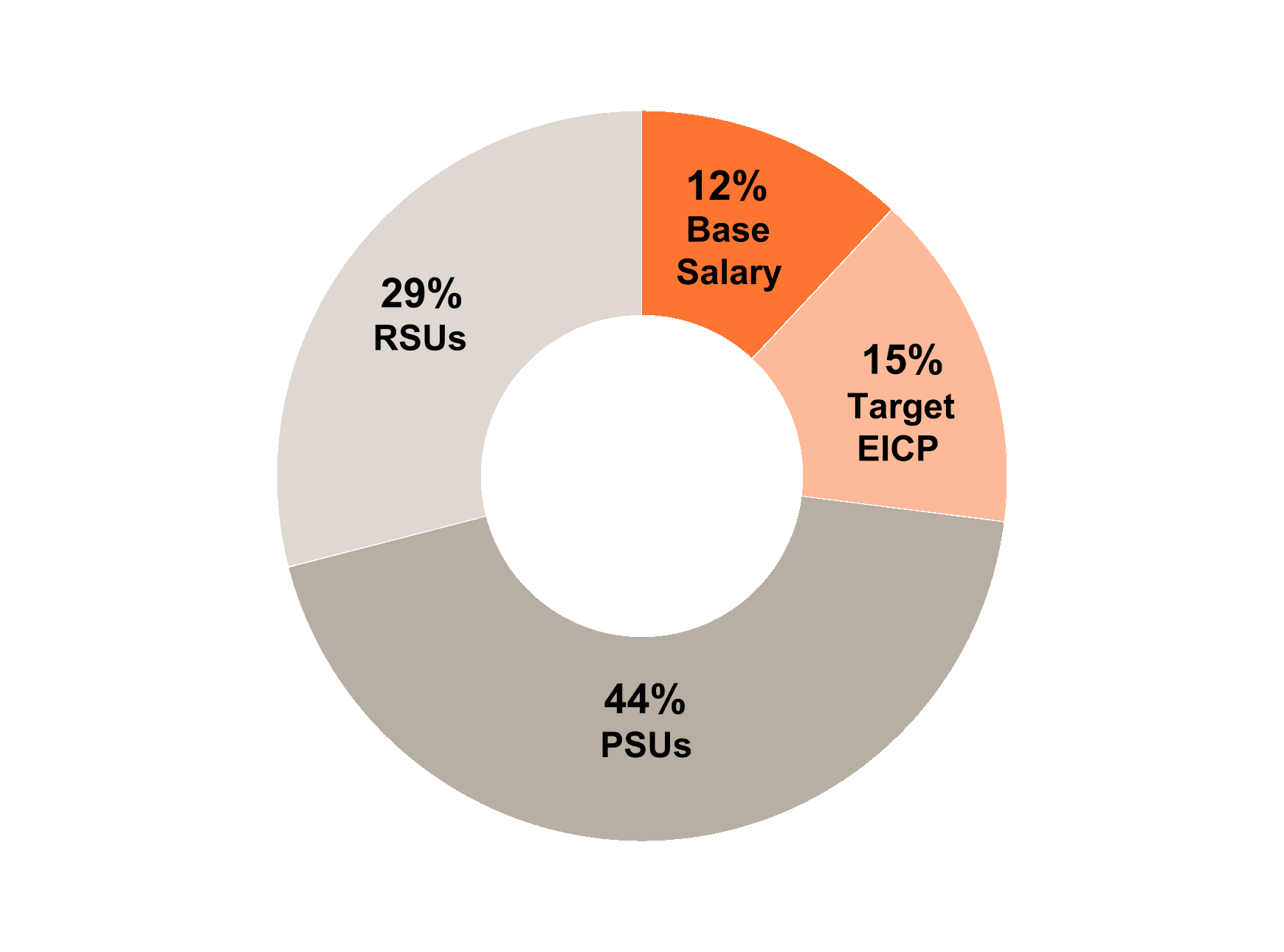
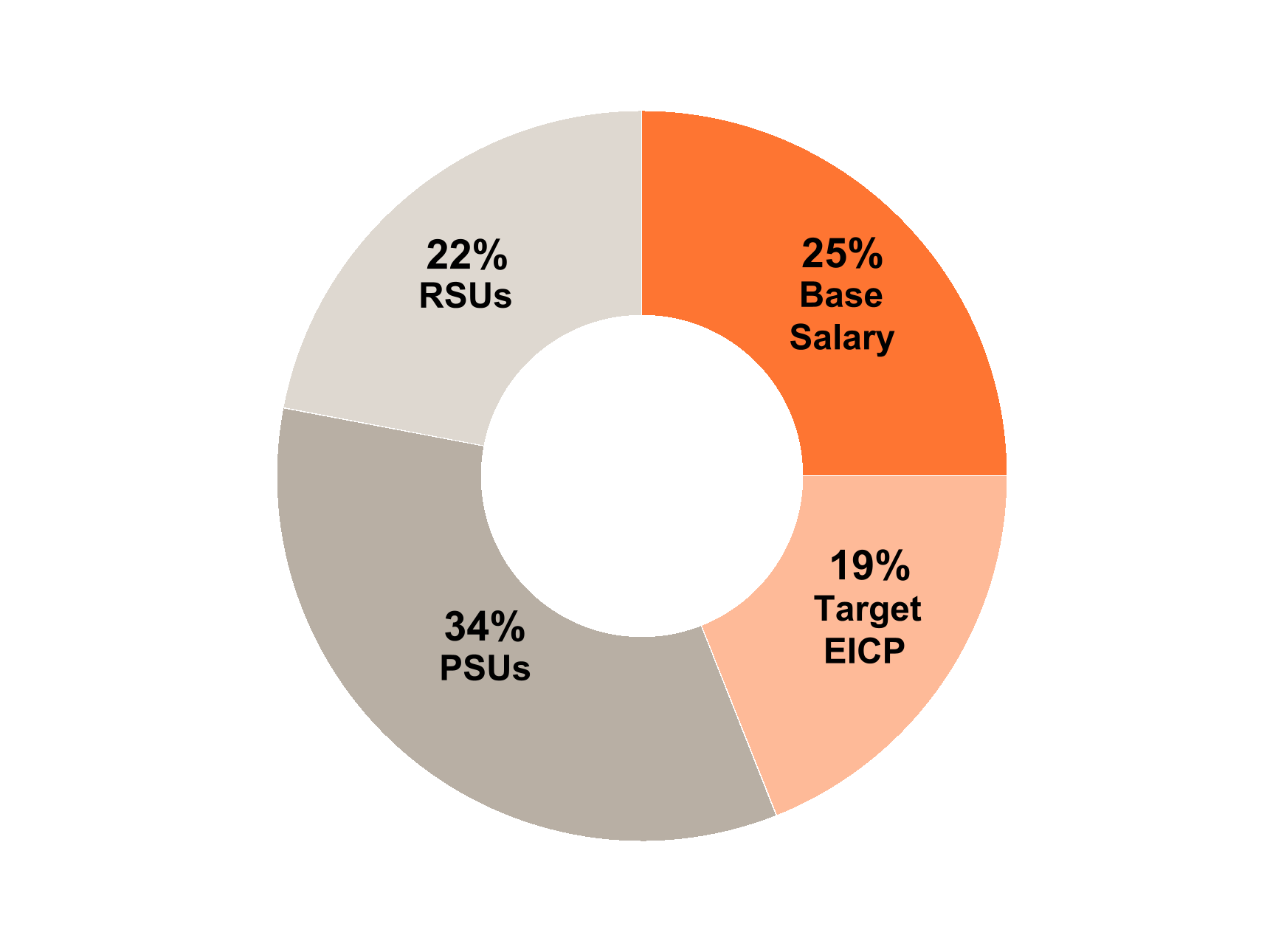


56%
Long-Term
73%
Long-Term

CEO
Compensation
59%
Performance-Based


Other NEO
Average
Compensation
53%
Performance-Based

2026 Executive Incentive Compensation Plan Design
Our 2026 EICP will not have a personal performance component and will be based entirely on the Company’s financial
performance. The Ralliant Compensation Committee believes that basing the NEOs’ EICP on financial performance metrics
appropriately aligns NEO and stockholder interests and focuses NEOs on achieving important business and financial priorities.
The 2026 EICP for executive officers will be based on the following performance measures:
EICP Metric | Metric Weight | How It Aligns with Ralliant’s Strategic Priorities |
Revenue | 40% | Incentivizes delivery of top-line growth |
Adjusted EBITDA | 40% | Incentivizes profit generation and cost discipline |
Free Cash Flow | 20% | Incentivizes free cash flow generation to enable execution of Ralliant’s capital allocation strategy |
52 | | |||
EXECUTIVE COMPENSATION |
2026 Long-Term Incentive Design
Annual long-term incentive awards granted to NEOs in 2026 consist of 60% PSUs and 40% RSUs. RSUs will vest in equal
tranches on the first, second, and third anniversaries of the grant date, subject to continued service through the applicable
vesting date. PSUs will vest following the end of the three-year performance period on December 31, 2028, subject to
continued service through the date on which the Ralliant Compensation Committee certifies performance of the PSUs based on
the following performance measures:
PSU Performance Metric | Metric Weight | How It Aligns with Ralliant’s Strategic Priorities |
Adjusted Diluted Earnings Per Share (“Adjusted EPS”) | 50% | Focus on sustainable, long-term financial performance and aligns management goals with stockholder value creation |
Relative Total Shareholder Return versus the S&P 400 MidCap Index (“rTSR”) | 50% | Aligns executive pay directly with stockholder experience, providing an objective, market-based measure of performance relative to peer firms |
The payout range of the PSUs is 0% to 200% depending on the achievement of Adjusted EPS and rTSR. The rTSR component
requires Ralliant TSR equal to the 55th percentile of peer firms to achieve the target payout. In addition, payout is capped at
100% if Ralliant’s TSR is negative, regardless of percentile rank. The PSUs also have a maximum value cap of five times the
target value.
Dividend equivalents will accrue and be reinvested in additional PSUs and RSUs subject to the same performance and vesting
conditions. Dividend equivalents are not paid to holders of RSUs or PSUs until the applicable awards vest.
Compensation-Setting Process
Role of the Ralliant Compensation Committee
The Ralliant Compensation Committee oversees the compensation of Ralliant’s executive officers. The Committee works
closely with the full Board, management, and its independent consultant to examine the effectiveness of the Company’s
compensation program and alignment with the Company strategy throughout the year. Specifically, the Committee:
•Sets Ralliant’s executive compensation philosophy;
•Reviews and approves the amount of compensation, goals, and objectives for the CEO, and in consultation with the CEO,
for the other executive officers;
•Sets the composition of the compensation peer groups;
•Approves long-term incentive grants to executive officers;
•Oversees risk management of Ralliant’s compensation programs, policies, and practices; and
•Assists the Board in its oversight of Ralliant’s human capital management practices.
The Ralliant Compensation Committee may form and delegate authority to subcommittees as it determines appropriate.
In addition, to the extent permitted by applicable law and the provisions of a given equity-based plan, the Committee may
delegate to one or more executive officers or a subcommittee the power to grant equity awards to employees of the Company
or its subsidiaries.
Role of the Independent Compensation Consultant
In connection with the Separation, the Ralliant Compensation Committee engaged Pearl Meyer to serve as its independent
compensation consultant. Pearl Meyer provides services related to Ralliant’s executive compensation program, including
reviewing and advising on:
•Our compensation peer groups;
•Compensation setting for the executive officers, including market benchmarking of pay levels;
•Market competitive practices among peers and their relevance for Ralliant as they relate to incentive design and
incentive goals;
•Form and amount of executive benefits and perquisites;
•Governance-related items including stock ownership guidelines, the compensation clawback policy, and treatment of equity
upon termination; and
•Compensation setting for the Board, including market benchmarking of pay levels.
2026 Proxy Statement | 53 | |||
EXECUTIVE COMPENSATION |
Pearl Meyer reports directly to the Ralliant Compensation Committee. As part of the engagement process, the Ralliant
Compensation Committee reviewed the independence of Pearl Meyer under NYSE and SEC rules and concluded that Pearl
Meyer is independent. In reaching this conclusion, the Ralliant Compensation Committee considered factors relevant to the
consultant’s independence, including the factors set forth in the NYSE listing standards.
Role of Management
Management assists the Ralliant Compensation Committee in discharging its duties by providing information on corporate and
individual performance as well as management’s perspective on certain compensation and human capital management
matters. The Ralliant Compensation Committee solicits and reviews the CEO’s recommendations with respect to the
compensation of executive officers (other than the CEO). Additionally, the Ralliant Compensation Committee considers relevant
market data, roles and responsibilities, and individual performance. Our CEO recuses herself from all discussions and
recommendations regarding her own compensation and is not present when her compensation is determined by the
independent Ralliant Compensation Committee.
Peer Group Benchmarking
The Ralliant Compensation Committee has developed a compensation peer group to better understand and evaluate the
appropriateness and competitiveness of Ralliant’s executive compensation. The analysis, construction, and design of the peer
group was informed by the peer group data and input from Pearl Meyer.
In order to compile an appropriate peer group, the Ralliant Compensation Committee reviewed a set of companies that included
some or all of the following characteristics:
•Publicly traded companies headquartered, and listed on a stock exchange, in the U.S.;
•Companies with revenue between approximately 1/3 to 3x of Ralliant’s revenue with consideration also given to operating
income, market capitalization, and enterprise value; and
•Companies representative of Ralliant’s segments, including Test & Measurement and Sensors & Safety Systems, as well as
our end markets, such as diversified electronics, industrial manufacturing, communications, defense and space, utilities, and
semiconductors.
Based on these criteria, the 2025 peer group included the following companies:
Badger Meter, Inc. | IDEX Corporation | Novanta, Inc. |
Cognex Corporation | Itron, Inc. | Nordson Corporation |
Crane Company | Keysight Technologies, Inc. | OSI Systems, Inc. |
Crane NXT, Co. | Littelfuse, Inc. | Teledyne Technologies Incorporated |
Curtiss-Wright Corporation | MKS Inc. | Teradyne, Inc. |
ESCO Technologies Inc. | MSA Safety Incorporated | Vontier Corporation |
The Ralliant Compensation Committee also considers data from the Radford Executive Compensation Survey and the Willis
Towers Watson Executive Compensation Survey, which are both utilized by Pearl Meyer in its competitive assessment of
executive compensation pay levels.
54 | | |||
EXECUTIVE COMPENSATION |
Other Compensation Matters
Stock Ownership Requirements
To further align management and stockholder interests and discourage inappropriate or excessive risk-taking, Ralliant has
adopted a stock ownership policy that requires each executive officer to obtain a substantial equity stake in Ralliant’s common
stock within five years of his or her appointment to an executive position. The multiples of base salary that the guidelines
require are as follows:
Executive Level | Stock Ownership Level (as a multiple of salary) |
Chief Executive Officer | 5.0x base salary |
All Other Executive Officers | 3.0x base salary |
Once an executive has acquired a number of shares that satisfies the ownership multiple, such number of shares then
becomes his or her minimum ownership requirement (even if the executive’s salary increases or the fair market value of such
shares subsequently changes) until he or she is promoted to a higher level.
Under the stock ownership policy, beneficial ownership includes shares in which the executive or his or her spouse or child has
a direct or indirect interest, notional shares of our common stock in the EDIP, shares held in a 401(k) plan, and unvested RSUs
but does not include shares subject to unexercised stock options or any PSUs.
Compensation Clawback Policy and Plan Terms
The Board has adopted the Ralliant Corporation Clawback Policy (the “Clawback Policy”) that applies to Ralliant’s Section
16 officers. Under the Clawback Policy, in the event of a material restatement of Ralliant’s consolidated financial statements
(other than any restatement required according to a change in applicable accounting rules), Ralliant will seek reimbursement of
the portion of any incentive-based compensation granted, earned, or vested based on the attainment of a financial reporting
measure that would not have been paid had the consolidated financial statements been correctly stated.
In addition to recoupment of incentive-based compensation mandated by the SEC and the NYSE, the Clawback Policy provides
the Ralliant Board with the discretion to also recoup additional incentive-based compensation, whether cash- or equity-based,
from any covered executive if the Ralliant Board determines that the triggering material restatement was at least in part the
result of gross misconduct by such covered executive.
Under the terms of the Ralliant Corporation 2025 Stock Incentive Plan (the “Stock Plan”), all outstanding unvested equity
awards will be terminated immediately upon, and no grantee may exercise any outstanding equity award after, such time as he
or she is terminated for gross misconduct. In addition, under the terms of the Ralliant EDIP if the plan administrator determines
that termination of an employee’s participation in the EDIP resulted from the employee’s gross misconduct, the plan
administrator may determine that the employee’s vesting percentage is zero with respect to all account balances that were
contributed by us.
Equity Award Grant Practices
The Ralliant Compensation Committee did not grant stock options to any NEO in 2025 during the period beginning four
business days before and ending one business day after the filing or furnishing of a Form 10-K, Form 10-Q, or Form 8-K that
disclosed material non-public information.
2026 Proxy Statement | 55 | |||
EXECUTIVE COMPENSATION |
Trading in Company Securities
Ralliant has adopted the Ralliant Corporation Insider Trading Policy (the “Insider Trading Policy”) that sets forth policies and
procedures governing the purchase, sale, and other transactions in Ralliant securities by directors, employees, and certain
other persons, and Ralliant has established procedures applicable to transactions by Ralliant itself, which Ralliant believes is
reasonably designed to promote compliance with insider trading laws, rules and regulations, and applicable listing standards.
A copy of our Insider Trading Policy was filed as Exhibit 19.1 to our Annual Report on Form 10-K for the fiscal year ended
December 31, 2025.
No Hedging or Pledging
The Insider Trading Policy includes prohibitions applicable to all employees, including NEOs, and directors against engaging at
any time in:
•Short sales of Ralliant securities;
•Transactions in any derivative of a Ralliant security, including puts, calls, or other options (except for instruments granted
under a Ralliant equity compensation plan);
•Other transactions designed to hedge or offset any decrease in the market value of Ralliant securities, including collars,
equity swaps, exchange funds, and prepaid variable forward sale contracts; or
•Holding Ralliant securities in a margin account or otherwise pledging Ralliant securities as collateral under any obligation,
including for a loan.
Tax Deductibility of NEO Compensation
Under Section 162(m) of the Code, compensation paid to each of the CEO, the CFO, and certain of our other NEOs
(collectively, “covered employees”) that exceeds $1 million per taxable year is generally non-deductible. Although the Ralliant
Compensation Committee may review and consider tax implications as one factor in determining executive compensation, the
Ralliant Compensation Committee also looks at other factors in making its decisions and retains the flexibility to provide
compensation for the Company’s covered employees in a manner consistent with the goals of the Company’s executive
compensation program and in the best interests of the Company and its stockholders, which may include providing for
compensation that is not deductible by the Company.
Compensation Risk Assessment
The Ralliant Compensation Committee engaged Pearl Meyer, its independent compensation consultant, to review our executive
and non-executive compensation programs for risk considerations. The Ralliant Compensation Committee determined, based
on the recommendations received from Pearl Meyer and its own analysis and conclusions, that none of the elements of our
compensation program encourage or create excessive risk-taking, and none is reasonably likely to have a material adverse
effect on the Company. The Ralliant Compensation Committee believes that our executive compensation program supports the
objectives described above without encouraging inappropriate or excessive risk-taking.
Compensation Committee Report
The Ralliant Compensation Committee has reviewed and discussed the Compensation Discussion and Analysis with Company
management and its independent compensation consultant. Accordingly, the Ralliant Compensation Committee recommended
to the Board that this Compensation Discussion and Analysis be included in this Proxy Statement and incorporated by
reference into the Company’s Annual Report on Form 10-K for the fiscal year ended December 31, 2025.
Ralliant Compensation Committee
Kate Mitchell (Chair)
Luis Müller
Neil Schrimsher
Ganesh Moorthy
56 | | |||
EXECUTIVE COMPENSATION |
Executive Compensation Tables
Summary Compensation Table
The following table provides certain information regarding the compensation of our NEOs for fiscal years 2025, 2024, and 2023.
Such compensation was paid or granted by Fortive prior to the completion of the Separation in June 2025 and by Ralliant after
the Separation.
Name and Principal Position | Year | Salary ($) | Bonus ($) | Stock Awards ($)(1) | Option Awards ($)(1) | Non-Equity Incentive Plan Compensation ($)(2) | Change in Pension Value and Non- Qualified Deferred Compensation Earnings ($)(3) | All Other Compensation ($)(4) | Total ($) | ||||||||
Tami Newcombe(5) President and Chief Executive Officer | 2025 | 936,539 | — | 4,606,587 | 5,062,103 | 1,251,250 | — | 572,617 | 12,429,096 | ||||||||
2024 | 738,942 | — | 3,515,675 | 1,357,595 | 1,111,860 | — | 148,346 | 6,872,418 | |||||||||
2023 | 681,731 | — | 3,077,780 | 1,154,736 | 1,262,588 | — | 98,746 | 6,275,581 | |||||||||
Neill Reynolds Senior Vice President – Chief Financial Officer | 2025 | 348,558 | 500,000 | 1,775,375 | 1,791,735 | 328,603 | — | 57,825 | 4,802,096 | ||||||||
Amir Kazmi Senior Vice President – Chief Technology and Growth Officer | 2025 | 395,577 | 250,000 | 1,677,762 | — | 275,128 | — | 61,126 | 2,659,593 | ||||||||
Jonathon Boatman Senior Vice President – Chief Legal Officer | 2025 | 454,808 | 250,000 | 1,004,357 | — | 337,343 | — | 76,075 | 2,122,583 | ||||||||
Karen Bick(5) Senior Vice President – Chief People Officer | 2025 | 465,442 | — | 1,436,088 | — | 387,296 | — | 80,093 | 2,368,919 | ||||||||
2024 | 439,635 | — | 399,621 | 419,716 | 304,612 | — | 56,886 | 1,620,470 | |||||||||
(1)The amounts reflected in these columns represent the aggregate grant date fair value of all equity awards that we granted to our NEOs,
computed in accordance with FASB ASC Topic 718. For all NEOs, the amount in the “Stock Awards” and “Option Awards” columns for 2025
equals the aggregate grant date fair value of all RSUs and stock options, respectively, that were granted to our NEOs during 2025.
With respect to RSUs, we calculated the grant date fair value under FASB ASC Topic 718 based on the base number of shares of common
stock underlying the RSU multiplied by the closing price of the common stock on the date of grant. With respect to stock options, we have
calculated the grant date fair value under FASB ASC Topic 718 using the Black-Scholes option pricing model. The assumptions made in
calculating the fair value of the RSUs and stock options granted on March 3, 2025 and the RSUs granted on May 15, 2025 are set forth in
Note 13: Stock-Based Compensation to the Consolidated Financial Statements in Fortive’s Annual Report on Form 10-K for fiscal 2025.
Additional information about the assumptions used when valuing the August 15, 2025 RSUs and stock options is set forth in Note 15:
Stock-Based Compensation to the Consolidated and Combined Financial Statements in our Annual Report on Form 10-K for fiscal 2025.
Fortive awards that were outstanding at the time of the Separation were converted into Ralliant awards in accordance with the Employee
Matters Agreement in a manner that preserved the award’s value. This conversion of the awards was considered a modification for
accounting purposes and resulted in additional compensation expense for Ralliant but did not result in additional value for any of the
relevant executives. The additional compensation expense recognized for each of the NEO converted awards was $4,234,095 for Ms.
Newcombe, $77,003 for Mr. Kazmi, $66,004 for Mr. Boatman, and $538,395 for Ms. Bick. Mr. Reynolds did not have any awards converted
or any additional compensation expense. For additional details, see Note 15: Stock-Based Compensation to the Consolidated and
Combined Financial Statements in our Annual Report on Form 10-K for fiscal 2025.
(2)The amounts set forth in this column for fiscal 2025 reflect compensation earned during the corresponding fiscal year under Ralliant’s
Executive Incentive Compensation Plan.
(3)Ralliant does not have a defined benefit pension plan for executive officers and does not pay above market earnings on account balances
under the EDIP or pursuant to any other deferred compensation arrangement.
2026 Proxy Statement | 57 | |||
EXECUTIVE COMPENSATION |
(4)The amounts set forth in this column for 2025 include the following benefits:
Name | 2025 Company 401(k) Contributions ($) | 2025 EDIP Company Contributions ($) | Financial Planning ($) | Relocation Costs ($)(i) | ||||
Tami Newcombe | 24,328 | 108,750 | 10,000 | 429,539 | ||||
Neill Reynolds | 11,538 | 36,287 | 10,000 | — | ||||
Amir Kazmi | 13,539 | 37,587 | 10,000 | — | ||||
Jonathon Boatman | 14,000 | 42,075 | 10,000 | 10,000 | ||||
Karen Bick | 24,328 | 45,765 | 10,000 | — | ||||
(i)Amounts represent relocation assistance provided under the Company’s Domestic Relocation Policy in connection with the executive's
relocation to Ralliant’s new headquarters in the Raleigh, North Carolina metropolitan area. For Ms. Newcombe, the amount includes
reimbursement of relocation expenses of $383,343 and related tax gross-up of $46,196. The Policy provides customary benefits that
may include home sale and home purchase assistance, shipment of household goods, temporary housing, travel costs, and a
$10,000 miscellaneous expense allowance.
(5)Compensation information for years prior to fiscal 2025 included for (i) Ms. Newcombe because such information was previously reported in
connection with her status as a named executive officer of Fortive during those periods and (ii) Ms. Bick because such information was
previously reported in our Information Statement filed with the SEC as an exhibit to our Form 10-12B/A on May 28, 2025.
58 | | |||
EXECUTIVE COMPENSATION |
Grants of Plan-Based Awards
The following table provides information regarding grants of plan-based awards to our NEOs during the fiscal 2025.
Name | Award Type | Grant Date | Estimated Future Payouts Under Non- Equity Incentive Plan Awards(1) | All Other Stock Awards: Number of Shares of Stock or Units (#)(2) | All Other Option Awards: Number of Securities Underlying Options (#)(2) | Exercise or Base Price of Option Awards ($/Share) | Grant Date Fair Value of Stock and Option Awards ($) (3) | ||||||||||
Approval Date | Threshold ($) | Target ($) | Maximum ($) | ||||||||||||||
Tami Newcombe | Annual Cash Incentive | — | — | 882,125 | 1,250,000 | 2,812,500 | — | — | — | — | |||||||
RSU | 3/3/2025 | 2/24/2025 | — | — | — | 41,876 | — | — | 2,184,719 | ||||||||
Stock Option | 3/3/2025 | 2/24/2025 | — | — | — | — | 126,883 | 52.87 | 2,613,222 | ||||||||
Stock Option | 8/15/2025 | 8/5/2025 | — | — | — | — | 54,563 | 43.50 | 1,015,391 | ||||||||
Stock Option | 8/15/2025 | 8/5/2025 | — | — | — | — | 48,251 | 43.50 | 955,653 | ||||||||
Stock Option | 8/15/2025 | 8/5/2025 | — | — | — | — | 24,126 | 43.50 | 477,836 | ||||||||
RSU | 8/15/2025 | 8/5/2025 | — | — | — | 23,342 | — | — | 1,008,141 | ||||||||
RSU | 8/15/2025 | 8/5/2025 | — | — | — | 21,969 | — | — | 942,470 | ||||||||
RSU | 8/15/2025 | 8/5/2025 | — | — | — | 10,985 | — | — | 471,257 | ||||||||
Neill Reynolds | Annual Cash Incentive | — | — | 396,956 | 562,500 | 1,265,625 | — | — | — | — | |||||||
Stock Option | 8/15/2025 | 8/5/2025 | — | — | — | — | 38,515 | 43.50 | 716,746 | ||||||||
Stock Option | 8/15/2025 | 8/5/2025 | — | — | — | — | 56,350 | 43.50 | 1,074,989 | ||||||||
RSU | 8/15/2025 | 8/5/2025 | — | — | — | 16,477 | — | — | 711,642 | ||||||||
RSU | 8/15/2025 | 8/5/2025 | — | — | — | 24,715 | — | — | 1,063,734 | ||||||||
Amir Kazmi | Annual Cash Incentive | — | — | 271,695 | 385,000 | 866,250 | — | — | — | — | |||||||
RSU | 5/15/2025 | 5/9/2025 | — | — | — | 15,185 | — | — | 728,921 | ||||||||
RSU | 8/15/2025 | 8/5/2025 | — | — | — | 21,969 | — | — | 948,841 | ||||||||
Jonathon Boatman | Annual Cash Incentive | — | — | 271,695 | 385,000 | 866,250 | — | — | — | — | |||||||
RSU | 5/15/2025 | 5/9/2025 | — | — | — | 13,016 | — | — | 624,803 | ||||||||
RSU | 8/15/2025 | 8/5/2025 | — | — | — | 8,788 | — | — | 379,554 | ||||||||
Karen Bick | Annual Cash Incentive | — | — | 234,645 | 332,500 | 748,125 | — | — | — | — | |||||||
RSU | 3/3/2025 | 2/24/2025 | — | — | — | 9,305 | — | — | 487,247 | ||||||||
RSU | 8/15/2025 | 8/5/2025 | — | — | — | 21,969 | — | — | 948,841 | ||||||||
(1)These columns relate to 2025 cash award opportunities under our Executive Incentive Compensation Plan, which we describe in more
detail above under “Executive Incentive Compensation Plan.” The amount that each NEO earned under these awards based on actual
performance for fiscal year 2025 appears in the “Non-Equity Incentive Plan Compensation” column of the Summary Compensation Table.
(2)All awards after the Separation were granted under the Stock Plan. We discuss the key terms of these awards in more detail above under
“Offer Letters and Awards Related to the Separation”. For any awards granted prior to the Separation, the shares were converted from their
original Fortive plan to the Stock Plan at the time of the Separation.
(3)Fortive awards that were outstanding at the time of the Separation were converted into Ralliant awards in accordance with the Employee
Matters Agreement in a manner that preserved the award’s value. This conversion of the awards was considered a modification for
accounting purposes and resulted in additional compensation expense for Ralliant but did not result in additional value for any of the
relevant executives. The additional compensation expense recognized for each of the NEO converted awards was $4,234,095 for
Ms. Newcombe, $77,003 for Mr. Kazmi, $66,004 for Mr. Boatman and $538,395 for Ms. Bick. Mr. Reynolds did not have any awards
converted or any additional compensation expense. For additional details, see Note 15: Stock-Based Compensation to the Consolidated
and Combined Financial Statements in our Annual Report on Form 10-K for fiscal 2025.
2026 Proxy Statement | 59 | |||
EXECUTIVE COMPENSATION |
Outstanding Equity Awards at Fiscal Year-End
The following table summarizes the number of securities underlying outstanding equity awards for each of our NEOs as of
December 31, 2025.
Name | Grant Date | Option Awards | Stock Awards | |||||||||
Number of Securities Underlying Unexercised Options Exercisable (#) | Number of Securities Underlying Unexercised Options Unexercisable (#) | Option Exercise Price ($) | Option Expiration Date | Number of Shares or Units of Stock That Have Not Vested (#)(1) | Market Value of Shares or Units of Stock That Have Not Vested ($)(1) | |||||||
Tami Newcombe | 8/15/2025 | — | 126,940 | (2) | 43.50 | 8/15/2035 | 56,296 | (6) | 2,866,029 | |||
3/3/2025 | — | 126,883 | (3) | 52.87 | 3/3/2035 | 41,876 | (3) | 2,131,907 | ||||
3/4/2024 | — | 60,542 | (3) | 56.74 | 3/4/2034 | 27,305 | (7) | 1,390,098 | ||||
2/27/2023 | — | 66,579 | (3) | 44.58 | 2/27/2033 | 53,605 | (8) | 2,729,031 | ||||
2/28/2022 | 13,786 | 13,787 | (3) | 43.33 | 2/28/2032 | 4,551 | (5) | 231,691 | ||||
11/15/2021 | 29,650 | — | 52.22 | 11/15/2031 | — | — | ||||||
2/24/2021 | 33,431 | — | 45.26 | 2/24/2031 | — | — | ||||||
2/20/2020 | 28,292 | — | 42.73 | 2/20/2030 | — | — | ||||||
5/15/2019 | 15,997 | — | 45.27 | 5/15/2029 | — | — | ||||||
2/25/2019 | 21,120 | — | 45.40 | 2/25/2029 | — | — | ||||||
2/22/2018 | 21,948 | — | 42.67 | 2/22/2028 | — | — | ||||||
2/23/2017 | 90,556 | — | 31.86 | 2/23/2027 | — | — | ||||||
Neill Reynolds | 8/15/2025 | — | 94,865 | (4) | 43.50 | 8/15/2035 | 41,192 | (9) | 2,097,085 | |||
Amir Kazmi | 8/15/2025 | — | — | — | — | 21,969 | (10) | 1,118,442 | ||||
5/15/2025 | — | — | — | — | 15,185 | (5) | 773,068 | |||||
Jonathon Boatman | 8/15/2025 | — | — | — | — | 8,788 | (10) | 447,397 | ||||
5/15/2025 | — | — | — | — | 13,016 | (5) | 662,645 | |||||
Karen Bick | 8/15/2025 | — | — | — | — | 21,969 | (10) | 1,118,442 | ||||
3/3/2025 | — | — | — | — | 9,305 | (5) | 473,718 | |||||
3/4/2024 | 5,385 | 16,165 | (5) | 56.74 | 3/4/2034 | 5,332 | (5) | 271,452 | ||||
2/27/2023 | 8,324 | 8,324 | (5) | 44.58 | 2/27/2033 | 2,747 | (5) | 139,850 | ||||
2/28/2022 | 9,054 | 3,021 | (5) | 43.33 | 2/28/2032 | 996 | (5) | 50,706 | ||||
2/24/2021 | 10,028 | — | 45.26 | 2/24/2031 | — | — | ||||||
11/15/2020 | 3,422 | — | 47.48 | 11/15/2030 | — | — | ||||||
(1)We calculated market value based on the closing price of our common stock on December 31, 2025, the last trading day of the year, as
reported on the NYSE ($50.91 per share), multiplied by the number of unvested shares.
(2)Includes 54,563 shares, where 50% of the options become exercisable on the first anniversary and one-fourth of the options granted
become or became exercisable on each of the second and third anniversaries of the grant date; includes 72,377 shares, where 50% of the
options become exercisable on the third and fourth anniversaries of the grant date.
(3)Under the terms of the award, vesting occurs in two equal installments of 50% on the third and fourth anniversaries of the grant date.
(4)Includes 38,515 shares, where 50% of the options become exercisable on the first anniversary and one-fourth of the options granted
become exercisable on each of the second and third anniversaries of the grant date; includes 56,350 shares, where 25% of the options
become exercisable on the first, second, third and fourth anniversaries of the grant date.
(5)Under the terms of the award, vesting occurs in four equal annual installments of 25% beginning on the first anniversary of the grant date.
(6)Includes 23,342 shares, where 50% of the awards vest on the first anniversary and 25% of the awards vest on the second and third
anniversaries of the grant date; includes 32,954 shares, where 50% of the awards vest on the third and fourth anniversaries of the
grant date.
(7)Includes 21,981 RSUs, of which 50% vest on each of the third and fourth anniversaries of the grant date. Also includes 5,324 shares that
were originally granted as PSUs under Fortive and were converted into RSUs in connection with the Separation based on the performance
payout as of the Separation date. These converted RSUs vest on the third anniversary of the grant date.
(8)Includes 27,473 RSUs, of which 50% vest on each of the third and fourth anniversaries of the grant date. Also includes 26,132 shares that
were originally granted as PSUs under Fortive and were converted into RSUs in connection with the Separation based on the performance
payout as of the Separation date. These converted RSUs vest on the third anniversary of the grant date.
(9)Includes 16,477 shares, where 50% of the awards vest on the first anniversary and 25% of the awards vest on the second and third
anniversaries; includes 24,715 shares, where 25% vest on the first, second, third, and fourth anniversaries of the grant date.
(10)Under the terms of the award, 50% of the awards vest on the first anniversary and 25% of the awards vest on the second and third
anniversaries of the grant date.
60 | | |||
EXECUTIVE COMPENSATION |
Option Exercises and Stock Vested During Fiscal 2025
The following table summarizes stock option exercises and the vesting of RSU awards with respect to our NEOs in 2025 that
occurred following the Separation.
Name | Option Awards | Stock Awards | ||||
Number of Shares Acquired on Exercise (#) | Value Realized on Exercise ($) | Number of Shares Acquired on Vesting (#) | Value Realized on Vesting ($)(1) | |||
Tami Newcombe | — | — | 4,893 | 232,222 | ||
Karen Bick | — | — | 3,787 | 165,637 | ||
(1)We calculated the amounts shown in this column by multiplying the number of shares acquired by the closing price of the common stock as
reported on the NYSE on the vesting date (or on the last trading day prior to the vesting date if the vesting date was not a trading day).
Non-Qualified Deferred Compensation
The following table sets forth, for each NEO, information regarding participation in the EDIP. There were no withdrawals by or
distributions to any of the NEOs from the EDIP in 2025.
Name | Executive Contributions in Last Fiscal Year ($)(1) | Registrant Contributions in Last Fiscal Year ($)(2) | Aggregate Earnings in Last Fiscal Year ($)(3) | Aggregate Balance at Last Fiscal Year End ($)(4) | ||||
Tami Newcombe | — | 108,750 | 36,439 | 598,298 | ||||
Neill Reynolds | — | 36,287 | 7,180 | 43,467 | ||||
Amir Kazmi | — | 37,587 | 2,617 | 42,961 | ||||
Jonathon Boatman | — | 42,075 | 2,661 | 43,694 | ||||
Karen Bick | 27,927 | 45,765 | 21,379 | 346,990 | ||||
(1)This column reflects the amount of base salary and non-equity incentive plan compensation that each NEO deferred in 2025 under our
EDIP as follows:
Name | Salary | Non-Equity Incentive Plan Compensation | |
Karen Bick | 27,927 | — | |
(2)We included the amounts set forth in this column as 2025 compensation under the “All Other Compensation” column of the Summary
Compensation Table.
(3)The amounts set forth in this column represent earnings that are neither above market nor preferential, and accordingly, we do not include
these amounts as compensation in the Summary Compensation Table.
(4)The table below indicates for each NEO how much of the EDIP balance set forth in this column that we have reported as compensation in
the Summary Compensation Table for previous years.
Name | Amount included in "Aggregate Balance at Last FYE" Column That Has Been Reported as Compensation in the Summary Compensation Table for Previous NEO Years ($) | |
Tami Newcombe | 174,300 | |
Karen Bick | 35,775 | |
2026 Proxy Statement | 61 | |||
EXECUTIVE COMPENSATION |
Potential Payments Upon Termination or Change-in-Control
Consistent with market practice, and to help ensure that Ralliant’s executive officers remain focused on our businesses during
periods of uncertainty and are motivated to pursue transactions in the best interests of stockholders, Ralliant maintains a
Severance and Change in Control Plan for Officers, which we refer to as the “Severance Plan.” It provides for severance
benefits upon (i) a termination without Cause not preceded by a change-in-control and (ii) a termination without Cause, or Good
Reason resignation (each, as defined in the Severance Plan), in each case, within 24 months following a qualified
change-in-control.
“Double Trigger” Change-in-Control Severance. The definition of “change-in-control” is limited to include only:
•a merger, consolidation, or reorganization in which Ralliant is not the surviving entity and in which the voting securities of
Ralliant prior to such transaction would represent 50% or less of the voting securities of the surviving entity;
•sale of all, or substantially all, assets of Ralliant, or
•any transaction approved by the Board that results in any person or entity that is not an affiliate of Ralliant owning 100% of
Ralliant’s outstanding voting securities.
If, within 24 months following a qualifying change-in-control, a NEO is terminated without Cause or resigns for Good Reason,
then the following severance payment would be due:
Compensation | CEO | OTHER NEOs |
Cash Severance Payment | 2x base salary and target annual incentive award | 1x base salary and target annual incentive award |
Cash Annual Incentive Award | Target annual incentive award prorated from the beginning of the year to the date of termination | Same |
Equity Awards | Immediate acceleration of all unvested outstanding equity awards, with any performance conditions measured based on target performance | Same |
Health Benefits | 24 months | 12 months |
280G Excise Tax | No tax gross up | Same |
Termination without Cause Severance. Ralliant provides the following severance benefits under the Severance Plan upon a
termination without Cause other than within 24 months following a qualifying change-in-control:
Compensation | CEO | OTHER NEOs |
Cash Severance Payment | 2x base salary | 1x base salary |
Cash Annual Incentive Award | •Payments based on actual performance; and •Prorated from the beginning of the year to the date of termination | Same |
Equity Awards | •Continued vesting of equity awards, prorated from the date of grant to the date of termination, with any performance conditions measured based on actual performance | Same |
Health Benefits | 24 months | 12 months |
280G Excise Tax | No tax gross up | Same |
The following table describes the payments and benefits that each NEO would be entitled to receive upon a termination of
employment or in connection with a change-in-control of Ralliant. The amounts set forth below assume that the triggering event
occurred on December 31, 2025. Where benefits are based on the market value of our common stock, we have used the
closing price of our common stock as reported on the NYSE on December 31, 2025, the last trading day of the year ($50.91 per
share). In addition to the amounts set forth below, upon any termination of employment, each executive would also be
entitled to (1) receive all payments generally provided to salaried employees on a non-discriminatory basis upon termination,
such as accrued salary, life insurance proceeds (for any termination of employment due to death), unused vacation, and 401(k)
plan distributions, (2) receive accrued, vested balances under the EDIP (except that under the EDIP, if an employee’s
employment terminates as a result of gross misconduct, the EDIP administrator may determine that the employee’s vesting
percentage with respect to all employer contributions is zero), and (3) exercise vested stock options (except that, under the
terms of our Stock Plan, all outstanding equity awards are terminated upon, and no employee can exercise any outstanding
equity award after, termination for gross misconduct). Retirement is defined generally as either a voluntary resignation after age
65 or an approved early retirement.
62 | | |||
EXECUTIVE COMPENSATION |
Name | Compensation Item | Termination Without Cause(1) ($) | Retirement ($) | Death ($) | Qualifying Termination in Connection with a Change-in-Control ($) | ||||
Tami Newcombe | Value of Unvested Stock Options that would be accelerated(2),(3) | 448,417 | 645,386 | 1,466,576 | 1,466,576 | ||||
Value of Unvested RSUs that would be accelerated(2),(3) | 3,829,603 | 4,547,434 | 5,572,558 | 9,348,756 | |||||
Benefits Continuation | 44,724 | — | — | 44,724 | |||||
Severance Payment | 2,000,000 | — | — | 4,500,000 | |||||
Target Annual Incentive Award(4) | — | — | — | 1,250,000 | |||||
Performance-Based Annual Incentive Award(4) | 1,251,250 | — | — | — | |||||
Value of unvested EDIP balance that would be accelerated(5) | — | — | — | — | |||||
Total | 7,573,994 | 5,192,820 | 7,039,134 | 16,610,056 | |||||
Neill Reynolds | Value of Unvested Stock Options that would be accelerated(2),(3) | — | — | 702,950 | 702,950 | ||||
Value of Unvested RSUs that would be accelerated(2),(3) | — | — | 1,249,586 | 2,097,085 | |||||
Benefits Continuation | 20,586 | — | — | 20,586 | |||||
Severance Payment | 625,000 | — | — | 1,187,500 | |||||
Target Annual Incentive Award(4) | — | — | — | 328,275 | |||||
Performance-Based Annual Incentive Award(4) | 328,603 | — | — | — | |||||
Value of unvested EDIP balance that would be accelerated(5) | — | — | 43,467 | — | |||||
Total | 974,189 | — | 1,996,003 | 4,336,395 | |||||
Amir Kazmi | Value of Unvested RSUs that would be accelerated(2),(3) | 234,797 | — | 1,194,960 | 1,891,510 | ||||
Benefits Continuation | 32,127 | — | — | 32,127 | |||||
Severance Payment | 550,000 | — | — | 935,000 | |||||
Target Annual Incentive Award(4) | — | — | — | 287,942 | |||||
Performance-Based Annual Incentive Award(4) | 275,128 | — | — | — | |||||
Value of unvested EDIP balance that would be accelerated(5) | — | — | 42,961 | — | |||||
Total | 1,092,052 | — | 1,237,921 | 3,146,579 | |||||
Jonathon Boatman | Value of Unvested RSUs that would be accelerated(2),(3) | 201,247 | — | 662,135 | 1,110,042 | ||||
Benefits Continuation | 19,374 | — | — | 19,374 | |||||
Severance Payment | 550,000 | — | — | 935,000 | |||||
Target Annual Incentive Award(4) | — | — | — | 328,059 | |||||
Performance-Based Annual Incentive Award(4) | 337,343 | — | — | — | |||||
Value of unvested EDIP balance that would be accelerated(5) | — | — | 43,694 | — | |||||
Total | 1,107,964 | — | 705,829 | 2,392,475 | |||||
Karen Bick | Value of Unvested Stock Options that would be accelerated(2),(3) | 65,482 | — | 75,590 | 75,590 | ||||
Value of Unvested RSUs that would be accelerated(2),(3) | 520,504 | — | 1,408,222 | 2,054,168 | |||||
Benefits Continuation | — | — | — | — | |||||
Severance Payment | 475,000 | — | — | 807,500 | |||||
Target Annual Incentive Award(4) | — | — | — | 332,500 | |||||
Performance-Based Annual Incentive Award(4) | 387,296 | — | — | — | |||||
Value of unvested EDIP balance that would be accelerated(5) | — | — | — | — | |||||
Total | 1,448,282 | — | 1,483,812 | 3,269,758 | |||||
2026 Proxy Statement | 63 | |||
EXECUTIVE COMPENSATION |
(1)A description of the severance benefits and cash payments our NEOs would be entitled to receive if we terminate the executive’s
employment without Cause, or upon termination following a change-in-control precedes this table. The amounts set forth in the table
assume that the executive would have executed our standard release in connection with any termination without Cause or termination
following a change-in-control.
(2)The terms of the Stock Plan provide for (a) continued pro-rata vesting of certain of the participant’s RSUs, PSUs, and stock options upon
retirement under certain circumstances, and (b) accelerated vesting of a participant’s stock options and certain of a participant’s RSUs and
PSUs if the participant dies during employment.
(3)Pursuant to the Severance Plan, in the event we terminate an NEO without Cause not in connection with a change-in-control, a prorated
portion of the NEO’s outstanding equity awards will remain outstanding and continue to vest pursuant to the original vesting schedule,
subject to the satisfaction of any performance measures that had not been met prior to the date of the termination. The remaining portion of
such unvested awards would be forfeited. If we terminate an NEO without Cause or an NEO resigns with Good Reason, in either case
within two years following a qualified change-in-control, all unvested equity awards shall become immediately vested (assuming, if
applicable, that any performance goals were met at the target level, irrespective of any actual performance).
(4)Pursuant to the Severance Plan, in the event we terminate an NEO without Cause not in connection with a change-in-control, a prorated
portion of the NEO’s annual incentive award will remain outstanding and be payable at the end of the performance period subject to the
satisfaction of any performance measures that had not been met prior to the date of the termination. If we terminate an NEO without Cause
or an NEO resigns with Good Reason, in either case within two years following a qualified change-in-control, a prorated portion of the
NEO’s target annual incentive award will immediately vest and be paid. None of the annual incentive awards are prorated for purposes of
the table since we assume that the NEO terminated employment on December 31, 2025, which is the end of the performance period for our
annual incentive awards, with assumed performance, in the case of a termination without Cause, based on actual performance and, in the
case of a termination following a change-in-control, based on target performance.
(5)Under the terms of the EDIP, any unvested portion of the employer contributions that have been credited to the participant’s EDIP account
would immediately vest upon the participant’s death. In 2025, Mr. Reynolds, Mr. Kazmi, and Mr. Boatman all had an unvested
EDIP balance.
64 | | |||
EXECUTIVE COMPENSATION |
Equity Compensation Plan Information
All data set forth in the table below is as of December 31, 2025.
Plan Category | Number of Securities to be Issued Upon Exercise of Outstanding Options, Warrants, and Rights (#) | Weighted-Average Exercise Price of Outstanding Options, Warrants and Rights(1) ($) | Number of Securities Remaining Available for Future Issuance under Equity Compensation Plans (Excluding Securities Reflected in Column (a)) (#) | ||
(a) | (b) | (c) | |||
Equity Compensation Plans Approved by Security Holders(2) | 4,266,357(3) | $44.94 | 9,633,919(4) | ||
Equity Compensation Plans Not Approved by Security Holders | — | — | — | ||
Total | 4,266,357 | $44.94 | 9,633,919 |
(1)The RSUs that have been issued under the Stock Plan do not require a payment by the recipient to us at the time of vesting. In addition,
under our EDIP, if a participant receives their EDIP distribution in shares of common stock, the participant’s EDIP balance is converted into
shares of common stock and distributed to the participant at no additional cost. As such, the weighted-average exercise price in column (b)
does not take these awards into account.
(2)Consists of the Stock Plan and the EDIP.
(3)Consists of shares attributable to the Stock Plan and shares attributable to the EDIP. Under the terms of the EDIP, upon distribution of a
participant’s EDIP balance the participant may elect to receive his or her distribution in cash, shares of common stock, or a combination of
cash and shares of common stock (except that any portion of a participant’s account that is subject to the common stock earnings rate must
be distributed in shares of common stock). For purposes of this table, we have assumed that all EDIP balances as of December 31, 2025
would be distributed in common stock.
(4)Consists of shares available for future issuance under the Stock Plan and, based on notional phantom shares representing outstanding
balances in EDIP accounts as of December 31, 2025, shares available for future issuance under the EDIP.
2026 Proxy Statement | 65 | |||
EXECUTIVE COMPENSATION |
The following table sets forth our pay versus performance disclosure, in accordance with SEC Item 402(v) of Regulation S-K
under the Exchange Act (“Item 402(v)”).
Pay versus Performance Table
Year | Summary Compensation Table Total for PEO(1) ($) | Compensation Actually Paid to PEO(2) ($) | Average Summary Compensation Table Total for Non-PEO NEOs(1) ($) | Average Compensation Actually Paid to Non-PEO NEOs(2) ($) | Total Shareholder Return(3) ($) | Peer Group Total Shareholder Return(4) ($) | Net Income ($) (in millions)(5) | Adjusted EPS(6) ($/Share) | ||||||||
2025 | ( | |||||||||||||||
(1)The principal executive officer (the “PEO”) and NEOs included in these columns reflect the following:
Year | PEO | Non-PEO NEOs |
2025 | Mr. Reynolds, Mr. Kazmi, Mr. Boatman, and Ms. Bick |
(2)The following table details the total equity award adjustments for the applicable year, including the amounts added (or subtracted, as
applicable) for the PEO and the non-PEO NEOs, as computed in accordance with Item 402(v). In general, the adjustments for equity
awards provided in Item 402(v) are as follows:
•Subtract the amounts reported in the “Stock Awards” and “Option Awards” columns of the Summary Compensation Table for the
applicable fiscal year,
•Add the fair value at fiscal year-end of option and stock awards granted in the covered fiscal year which were outstanding and unvested
at the end of the covered fiscal year,
•Add the change in fair value (which may be a negative number) as of the end of the covered fiscal year as compared to the value at the
end of the prior fiscal year for option and stock awards which were granted in prior fiscal years and were outstanding and unvested at
the end of the covered fiscal year,
•Add the vesting date value of option and stock awards which were granted and vested during the same covered fiscal year,
•Add the change in value (which may be a negative number) as of the vesting date as compared to the value at the end of the prior fiscal
year for option and stock awards which were granted in prior fiscal years and vested in the covered fiscal year,
•Subtract as to any option and stock awards which were granted in prior fiscal years and failed to meet applicable vesting conditions
during the covered fiscal year, the value of such awards as of the end of the prior fiscal year,
•Plus the dollar value of any dividends or other earnings paid during the covered fiscal year on outstanding and unvested awards.
•Plus, as to any option or stock award that was materially modified during the covered fiscal year, the amount by which the value of the
award as of the date of the modification exceeds the value of the original award on the modification date.
In making each of these adjustments, the “value” of an option or stock award is the fair value of the award on the applicable
date determined in accordance with FASB ASC Topic 718 using the valuation assumptions used to calculate the fair value of
our equity awards. For more information on the valuation of the equity awards, please see the notes to the financial
statements that appear in Ralliant’s Annual Report on Form 10-K each fiscal year and the footnotes to the Summary
Compensation Table that appears in our annual proxy statement.
66 | | |||
EXECUTIVE COMPENSATION |
Reconciliation of Compensation Actually Paid to Summary Compensation Table
PEO | NEO Average | |||
2025 ($) | 2025 ($) | |||
Summary Compensation Table Total | ||||
Less: Grant Date Fair Value of Equity Awards Granted in the Fiscal Year | ( | ( | ||
Add: Fair Value at Fiscal Year-End of Outstanding and Unvested Equity Awards Granted in the Fiscal Year | ||||
Add/(Less): Change in Fair Value of Outstanding and Unvested Equity Awards Granted in Prior Fiscal Years | ( | |||
Add: Fair Value at Vesting of Equity Awards Granted and Vested in the Fiscal Year | ||||
Add/(Less): Change in Fair Value as of the Vesting Date of Equity Awards Granted in Prior Fiscal Years that Vested in the Fiscal Year | ( | ( | ||
Less: Fair Value as of the Prior Fiscal Year End of Equity Awards Granted in Prior Fiscal Years that Failed to Meet Vesting Conditions in the Fiscal Year | ||||
Add: Value of Dividends or Other Earnings Paid on Equity Awards Not Otherwise Reflected in Total Compensation | ||||
Compensation Actually Paid | ||||
(3)Assumes $100 invested on market close on June 30, 2025, the Separation date, through the end of the fiscal year for which Total
Shareholder Return (“TSR”) is being calculated. TSR is calculated by dividing the sum of the cumulative amount of dividends for the
measurement period, assuming dividend reinvestment, and the difference between the Company’s share price at the end and the beginning
of the measurement period by the Company’s share price at the beginning of the measurement period.
(4)Represents the peer group TSR, weighted according to the respective companies’ stock market capitalization at the beginning of each
period for which a return is indicated. The peer group used for this purpose is the S&P 600 Industrials Index.
(5)Amount reflects Ralliant Corporation’s net income as calculated pursuant to GAAP and reported in our audited financial statements.
(6)Amount reflects Ralliant Corporation’s adjusted EPS , a non-GAAP measure, as our Company-selected measure. See “Appendix - Non-
GAAP Financial Measures” for a reconciliation of non-GAAP measures to the most directly comparable GAAP measures.
The assumptions used to calculate the fair value of equity awards in this section do not materially differ from those used to
calculate the grant date fair value of such awards for purposes of the Summary Compensation Table, except that the fair value
calculations of unvested options in 2025 rely upon an estimated term of 1.4 to 7.4 years, as compared to the six-year estimated
term relied upon to calculate the grant date fair value of such stock options.
the list below provides, in no particular order, the financial performance measures that Ralliant believes are most important for
purposes of linking compensation actually paid to the NEOs during fiscal 2025 to Ralliant’s performance:
•Adjusted EPS
•Adjusted Operating Profit
•Organic Revenue Growth
•Working Capital Turnover
Pay versus Performance Table Discussion and Analysis. In accordance with Item 402(v) requirements, Ralliant is providing the
following charts to describe the relationships between information presented in the Pay versus Performance table. The following
charts show the relationship between the compensation actually paid (also referred to as “CAP”) to the PEO and the other
NEOs and (i) TSR of both Ralliant and the S&P 600 Industrials Index; (ii) Ralliant’s net income; and (iii) Ralliant’s adjusted EPS.
2026 Proxy Statement | 67 | |||
EXECUTIVE COMPENSATION |
Relationship Between Compensation Actually Paid and Performance Measures Disclosed in the Pay
versus Performance Table
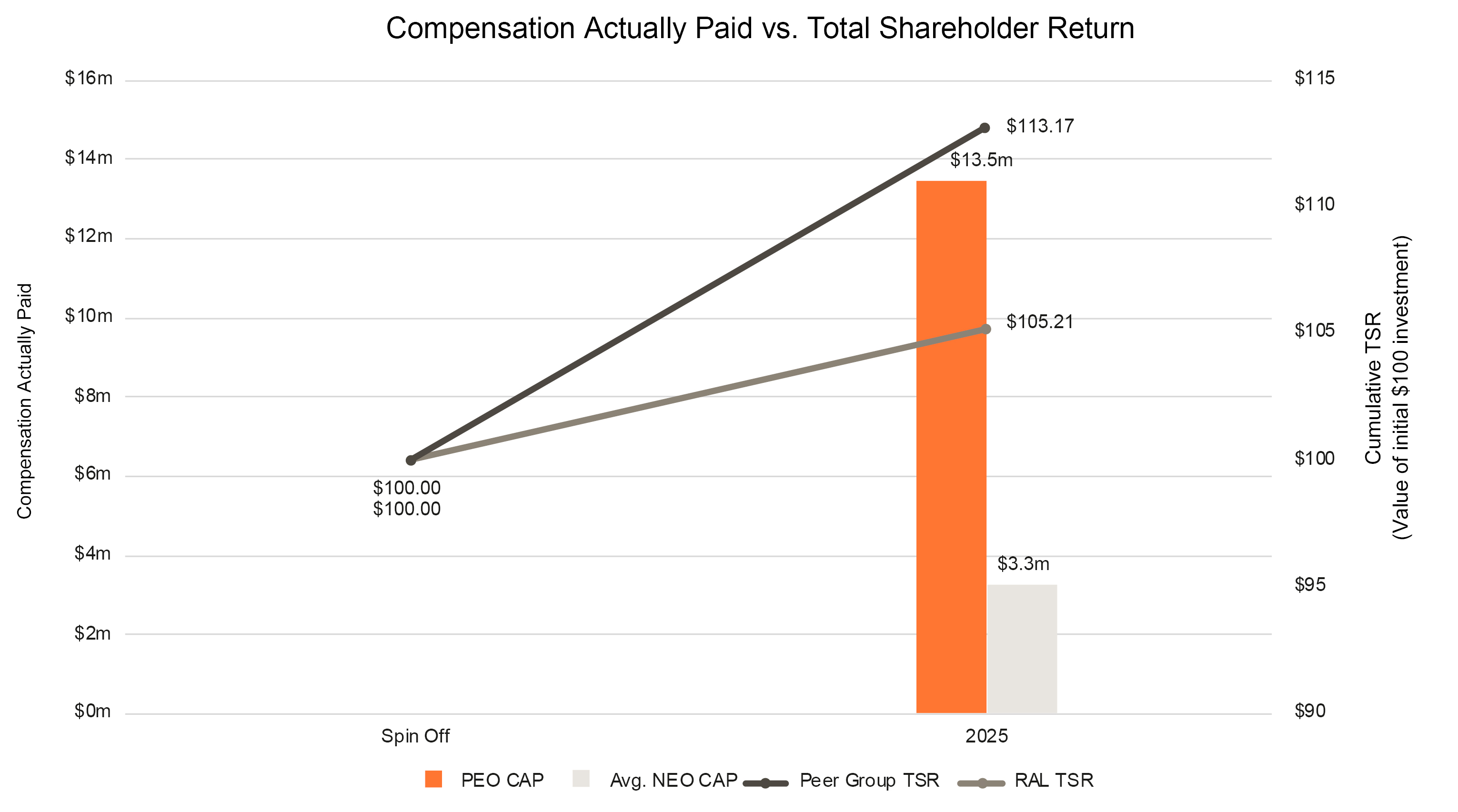
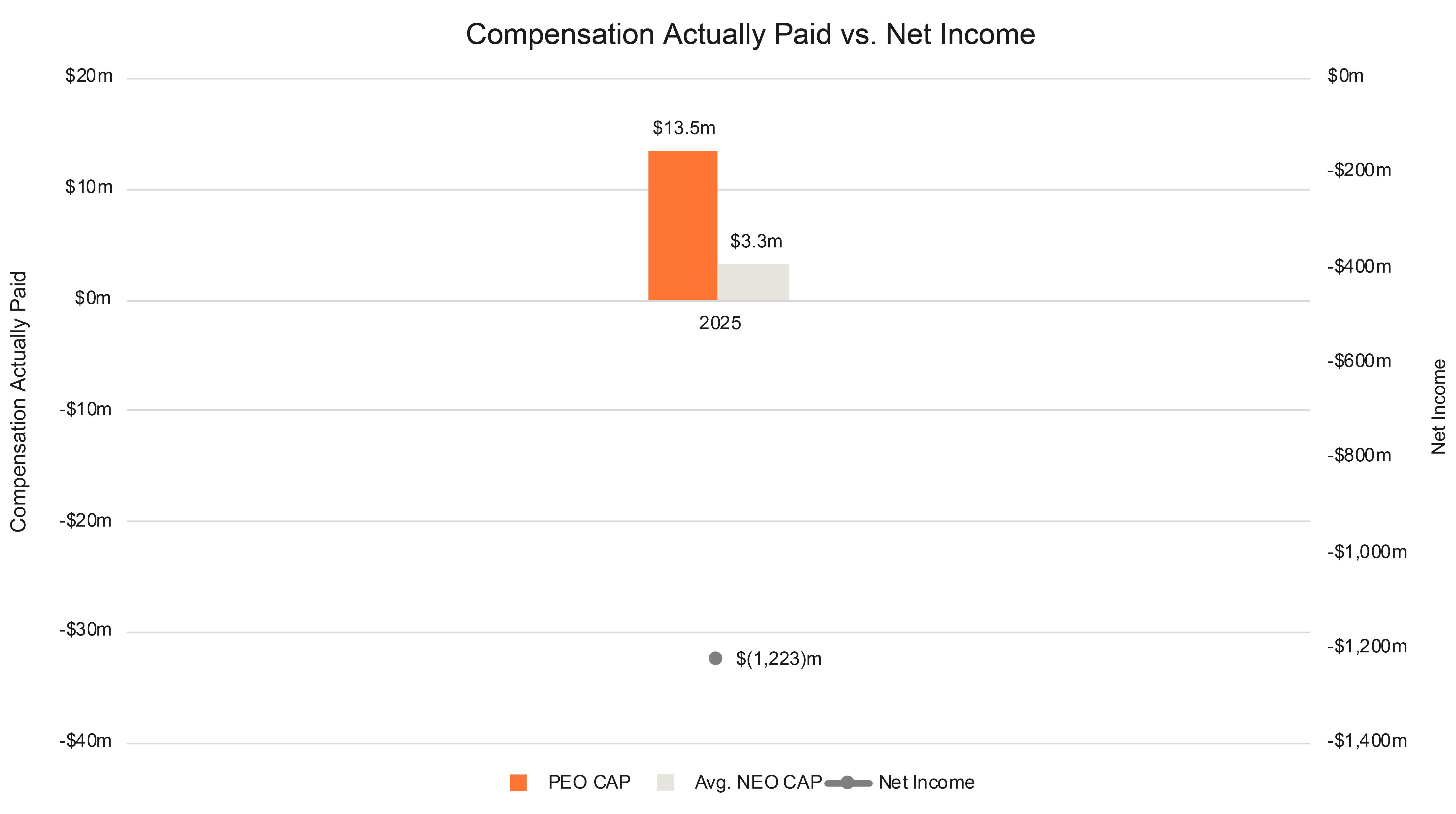
68 | | |||
EXECUTIVE COMPENSATION |
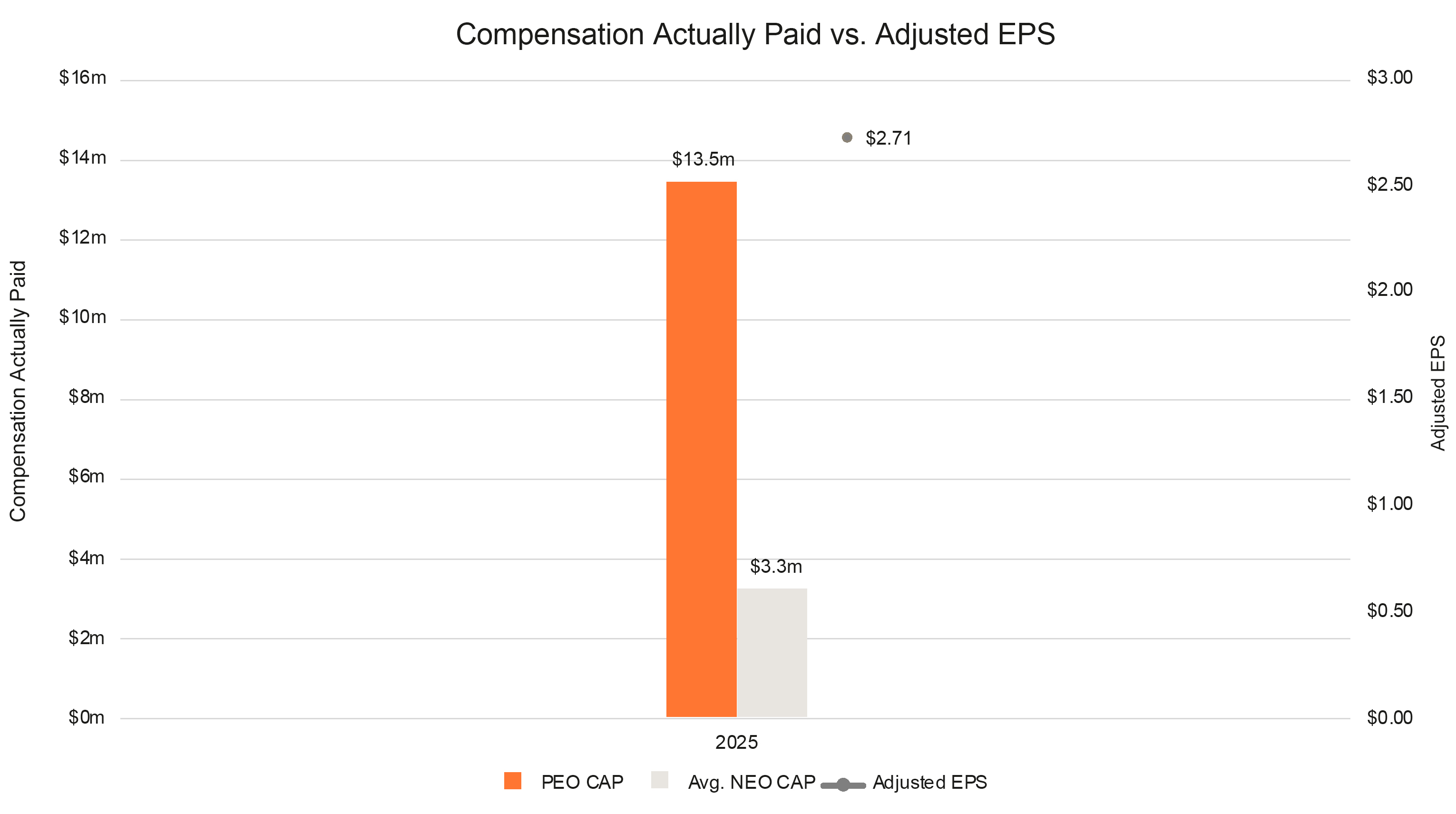
Compensation Committee Interlocks and
Insider Participation
Kate Mitchell, Luis Müller, Neil Schrimsher, and Ganesh Moorthy served on the Compensation Committee in fiscal 2025.
None of the directors who served on the Compensation Committee in fiscal 2025 has ever served as one of the Company’s
officers or employees or had any relationship with the Company or any of its subsidiaries during fiscal 2025 pursuant to which
disclosure would be required under the SEC rules pertaining to the disclosure of transactions with related persons. During fiscal
2025, none of the Company’s executive officers served as a director or member of the compensation committee (or other
committee performing similar functions) of any other entity of which an executive officer of such other entity served on the
Company’s Board or the Compensation Committee.
2026 Proxy Statement | 69 | |||

PROPOSAL 4:
Ratification of the Appointment of Ernst & Young LLP as
Ralliant’s Independent Auditor for Fiscal 2026
The Audit Committee is directly responsible for the appointment, retention, compensation, evaluation, and oversight of Ralliant’s
independent auditor. The Audit Committee has appointed Ernst & Young LLP (“Ernst & Young”) to serve as Ralliant’s
independent auditor for the fiscal year 2026.
The Audit Committee and the Board believe that the continued retention of Ernst & Young to serve as Ralliant’s independent
auditor is in the best interests of Ralliant and its stockholders.
Although stockholder ratification is not required, the Board is asking stockholders to ratify this appointment as a matter of good
corporate governance. If stockholders do not ratify the appointment of Ernst & Young, the Audit Committee will consider any
information submitted by stockholders in connection with the appointment of the independent auditor for the next year. Even if
the appointment is ratified, the Audit Committee, in its discretion, may direct the appointment of a different independent auditor
at any time during the fiscal year if the Audit Committee determines that such a change would be in the best interests of Ralliant
and its stockholders.
Representatives of Ernst & Young are expected to participate in the Annual Meeting, where they will have the opportunity to
make a statement if they desire to do so. They also are expected to be available to respond to appropriate questions.
| The Board recommends a vote FOR the ratification of the appointment of Ernst & Young as Ralliant’s independent auditor for fiscal 2026. | ||
Independent Auditor Fees
Concurrently with the Separation, the Audit Committee appointed Ernst & Young to act as the independent auditor for the
Company and its consolidated subsidiaries for the fiscal year ended December 31, 2025. Aggregate fees billed to Ralliant for
professional services rendered by Ernst & Young for fiscal 2025 following the Separation are set forth in the table below. For the
fiscal year ended December 31, 2024, Ralliant did not pay any fees for professional services to Ernst & Young. Prior to the
Separation, Fortive Corporation paid certain audit, audit-related, tax, or other fees related to Ralliant’s businesses and those
have been excluded from the table below.
2025 ($) | |
Audit Fees(1) | 5,801,966 |
Audit-Related Fees(2) | 300,000 |
Tax Fees(3) | 199,947 |
All Other Fees(4) | 5,200 |
Total Fees | 6,307,113 |
(1)Audit Fees consist of fees for the audit of annual financial statements, reviews of quarterly financial statements, statutory audits, audit of
captive insurance company, audit procedures associated with the adoption of new accounting standards, consents, review of documents
filed with the SEC, and other services normally provided by the auditor in connection with statutory and regulatory filings or engagements.
(2)Audit-Related Fees consist of assurance and related services provided by Ernst & Young that are reasonably related to the performance of
the audit or review of our financial statements and are not reported above under “Audit Fees.” Fees for audit-related services primarily
related to agreed-upon procedures and other attestation services.
(3)Tax Fees consist of fees billed for professional services for tax compliance, tax advice, and tax planning.
(4)All Other Fees consist of fees for products and services provided by Ernst & Young, other than the services reported under “Audit Fees,”
“Audit-Related Fees,” or “Tax Fees” above.
70 | | |||
PROPOSAL 4: RATIFICATION OF THE APPOINTMENT OF ERNST & YOUNG LLP AS RALLIANT’S INDEPENDENT AUDITOR FOR FISCAL 2026 |
Audit Committee Pre-Approval of Services of
Independent Auditor
The Audit Committee pre-approves all auditing services and permitted non-audit services to be performed for Ralliant by the
independent auditor. The Audit Committee will consider and, if appropriate, pre-approve the provision of audit and permitted
non-audit services. We maintain procedures requiring that, prior to engagement, all services performed by Ernst & Young must
be pre-approved so that no prohibitive services are inadvertently engaged in and the independence of Ernst & Young is
maintained. The Audit Committee Chair has the delegated authority to pre-approve such services, provided that any approval
by the Audit Committee Chair must be presented to the Audit Committee at its next meeting.
All audit, audit-related, tax, and other services provided by Ernst & Young in 2025 were approved by the Audit Committee.
Audit Committee Report
The Audit Committee is comprised entirely of independent directors who meet the independence requirements of the NYSE and
the SEC. The Audit Committee operates under a written charter that is available on the Investors section of Ralliant’s website,
https://investors.ralliant.com, under “Governance.”
In performing its responsibilities, the Audit Committee has:
•Reviewed and discussed Ralliant’s audited financial statements for the fiscal year ended December 31, 2025
with management;
•Discussed with Ralliant’s independent auditor, Ernst & Young, the matters required to be discussed by the applicable
requirements of the Public Company Accounting Oversight Board (the “PCAOB”) and the SEC; and
•Received the written disclosures and the letter from Ernst & Young required by the applicable requirements of the PCAOB
regarding the independent accountant’s communications with the Audit Committee concerning independence, and has
discussed with Ernst & Young its independence.
Based on the reviews and discussions described above, the Audit Committee recommended to the Board that the audited
financial statements be included in Ralliant’s Annual Report on Form 10-K for the fiscal year ended December 31, 2025.
Ralliant Audit Committee
Brian Worrell (Chair)
Kevin Bryant
Kate Mitchell
Anelise Sacks
Neil Schrimsher
2026 Proxy Statement | 71 | |||
Security Ownership of Certain
Beneficial Owners
The following table sets forth, as of April 9, 2026 (unless otherwise specified), the number of shares and percentage of Ralliant
common stock beneficially owned by:
•each person or group known by Ralliant to beneficially own more than 5% of Ralliant common stock;
•each of Ralliant’s directors and named executive officers; and
•all directors and executive officers of Ralliant as a group.
The percentage of beneficial ownership in the following tables is based on 111,929,605 shares of Ralliant common stock
outstanding. Beneficial ownership is determined in accordance with the rules of the SEC, pursuant to which an individual or
entity is generally deemed to beneficially own any shares as to which the individual or entity has sole or shared voting or
investment power, including any shares that the individual or entity has the right to acquire within 60 days through the exercise
of any stock options, through the vesting or settlement of RSUs or PSUs, or upon the exercise of other rights. Unless otherwise
indicated in the footnotes to the following table, to Ralliant’s knowledge all persons listed below have sole voting and investment
power with respect to the shares of Ralliant common stock beneficially owned by them, subject to applicable community
property laws. Unless otherwise indicated in the following table, the address for each stockholder listed below is c/o Ralliant
Corporation, 4114 Center at North Hills Street, Suite 400, Raleigh, North Carolina 27609.
Name and Address of Beneficial Owner | Number of Shares of Common Stock(1) | Percentage of Common Stock Outstanding |
5% Beneficial Owner | ||
The Vanguard Group(2) | 14,589,194 | 13.0 |
100 Vanguard Blvd., Malvern, PA 19355 | ||
BlackRock, Inc.(3) | 12,646,395 | 11.3 |
50 Hudson Yards New York, NY 10001 | ||
Dodge & Cox(4) | 12,010,913 | 10.7 |
555 California Street 40th Floor, San Francisco, CA 94104 | ||
Directors and Executive Officers | ||
Karen Bick(5) | 53,717.3 | * |
Jonathon Boatman(6) | 4,634.5 | * |
Kevin Bryant | 1,250 | * |
Amir Kazmi(7) | 7,712.9 | * |
Kate Mitchell(8) | 3,770 | * |
Ganesh Moorthy | 8,434 | * |
Luis Müller | — | * |
Tami Newcombe(9) | 348,302.4 | * |
Neill Reynolds | — | * |
Anelise Sacks | 5,403 | * |
Neil Schrimsher | — | * |
Alan Spoon | 29,427 | * |
Brian Worrell | 5,904 | * |
All Directors and Executive Officers as a Group (13 persons) | 468,555.2 | * |
72 | | |||
SECURITY OWNERSHIP OF CERTAIN BENEFICIAL OWNERS |
(1)Balances credited to each executive officer’s account under the EDIP that are vested or are scheduled to vest within 60 days of April 9,
2026 are included in the table. The incremental number of notional phantom shares of common stock credited to a person’s EDIP account
is based on the incremental amount of contribution to the person’s EDIP balance divided by the closing price of the common stock as
reported on the NYSE on the business day last preceding the date of the contribution.
(2)The amount shown and the following information is derived from a Schedule 13G/A filed October 30, 2025 by The Vanguard Group, which
sets forth its beneficial ownership as of September 30, 2025. According to the Schedule 13G/A, The Vanguard Group had shared voting
power over 692,273 shares, sole dispositive power over 13,628,294 shares, and shared dispositive power over 960,900 shares. On March
27, 2026, the Vanguard Group filed another Schedule 13G/A reporting that due to an internal realignment it no longer has, or is deemed to
have, beneficial ownership over Ralliant securities beneficially owned by various Vanguard subsidiaries or business divisions of
subsidiaries. The Vanguard Group also reported that certain subsidiaries or business divisions of subsidiaries that formerly had, or were
deemed to have, beneficial ownership with The Vanguard Group will report beneficial ownership separately (on a disaggregated basis) from
The Vanguard Group.
(3)The amount shown and the following information is derived from a Schedule 13G/A filed October 17, 2025 by BlackRock, Inc. which sets
forth its beneficial ownership as of September 30, 2025. According to the Schedule 13G/A, BlackRock, Inc. has sole voting power over
12,354,430 shares and sole dispositive power over 12,646,395 shares.
(4)The amount shown and the following information is derived from a Schedule 13G/A filed November 6, 2025 by Dodge & Cox, which sets
forth its beneficial ownership as of October 31, 2025. According to the Schedule 13G/A, Dodge & Cox has sole voting power over
11,308,290 shares and sole dispositive power over 12,010,913 shares.
(5)Includes options to acquire 48,785 shares and 4,932.3 notional phantom shares attributable to Ms. Bick’s EDIP account.
(6)Includes 1,380.5 notional phantom shares attributable to Mr. Boatman’s EDIP account.
(7)Includes 1,370.9 notional phantom shares attributable to Mr. Kazmi’s EDIP account.
(8)Includes 3,770 shares held by The Wesley and Katherine Mitchell Living Trust, a family trust of which Ms. Mitchell and her spouse are
trustees and sole beneficiaries.
(9)Includes options to acquire 301,856 shares and 14,681.4 notional phantom shares attributable to Ms. Newcombe’s EDIP account.
*Represents less than 1%.
2026 Proxy Statement | 73 | |||
Submitting 2027
Stockholder Proposals
The table below summarizes the requirements for stockholders who wish to submit proposals, including director nominations,
for the 2027 Annual Meeting. Stockholders are encouraged to consult Rule 14a-8 of the Exchange Act (“SEC Rule 14a-8”) and
our Bylaws, as applicable, to see all applicable requirements.
Proposals for Inclusion in 2027 Proxy Statement | Other Proposals/Nominees to be Presented at the 2027 Annual Meeting | |
Type of Proposal | SEC rules permit stockholders to submit proposals for inclusion in our proxy statement by satisfying the requirements specified in SEC Rule 14a-8 | Stockholders who wish to present proposals or director nominations directly at the 2027 Annual Meeting (but not for inclusion in our proxy statement) must satisfy the requirements specified in our Bylaws as applicable; stockholders who wish to nominate directors must also include all information required by Rule 14a-19 under the Exchange Act |
When Proposal Must Be Received by Ralliant | No later than December 24, 2026 | No earlier than February 5, 2027 and no later than March 7, 2027 (unless the 2027 Annual Meeting is held more than 30 days before or after the first anniversary of the Annual Meeting, in which case the deadline is no later than 10 days following the date of Public Disclosure (as defined in the Bylaws) of the date of the 2027 Annual Meeting) |
Where to Send | By Mail: Ralliant Corporation Attn: Corporate Secretary 4114 Center at North Hills Street Suite 400 Raleigh, North Carolina 27609 | |
74 | | |||
Voting and Meeting Information
Voting Standards and Board Recommendations
The following summarizes the Board’s voting recommendations for each proposal, the vote required for each proposal to pass,
and the effect of abstentions and broker non-votes on each proposal.
Proposal | Board Recommendation | Voting Standards | Treatment of Abstentions | Treatment of Broker Non-Votes |
1. Election of Directors | FOR each Class I director nominee | Majority of votes cast at the Annual Meeting | Not counted as votes cast and therefore no effect | Not counted as votes cast and therefore no effect |
2. Say-on-Pay | FOR | Affirmative vote of the holders of a majority of the total number of votes of common stock represented at the Annual Meeting and entitled to vote on the proposal | Same as vote against | Not counted as entitled to vote and therefore no effect |
3. Say-on- Frequency | 1 YEAR | The option of 1 year, 2 years or 3 years that receives the greatest number of affirmative votes of the holders of the shares of common stock represented at the Annual Meeting and entitled to vote on the proposal | Not counted as an affirmative vote for any option and therefore no effect | Not counted as entitled to vote and therefore no effect |
4. Ratification of Appointment of Independent Auditor | FOR | Affirmative vote of the holders of a majority of the total number of votes of common stock represented at the Annual Meeting and entitled to vote on the proposal | Same as vote against | Not applicable (expected to be a routine matter) |
We Have a Majority Voting Standard for Director Elections: Each director nominee who receives a majority of the votes
cast will be elected, except in a contested election (as described in Ralliant’s Bylaws) where director nominees are elected by a
plurality of the votes cast. Any current director who does not meet this standard is subject to the Board’s policy regarding
resignations by directors for whom the number of votes cast “For” does not exceed the number of votes cast “Against” in an
uncontested election, which is described in Ralliant’s Bylaws and Corporate Governance Guidelines. All other matters are
approved if supported by the affirmative vote of the holders of a majority of the total number of votes of common stock
represented at the Annual Meeting and entitled to vote thereon.
Meeting Information
The Annual Meeting will be conducted in an online-only meeting format via audio webcast. The virtual meeting will be governed
by our rules of conduct, which will be posted on the virtual meeting platform on the date of the Annual Meeting.
How Do I Attend the Virtual Annual Meeting?
To participate in the meeting, you must have your 16-digit control number that is shown on your Notice of Internet Availability of
Proxy Materials (“Notice”), or if you received a printed copy of the proxy materials, on your proxy form or the voting instruction
form that accompanied your proxy materials. If the Notice or voting instruction form that you received does not indicate that you
may vote your shares through the www.proxyvote.com website, you should contact your bank, broker, or other nominee
(preferably at least five days before the Annual Meeting) and obtain a “legal proxy” (which will contain a 16-digit control number
that will allow you to attend, participate in, or vote at the meeting). Anyone may access the Annual Meeting by visiting
www.virtualshareholdermeeting.com/RAL2026. If you encounter any difficulties accessing the Annual Meeting during the
check-in or meeting time, please call the technical support number that will be posted on the Annual Meeting log-in page.
Technical support will be available starting 15 minutes prior to the meeting. We will post a recording of the Annual Meeting on
the Investors section of Ralliant’s website, https://investors.ralliant.com.
2026 Proxy Statement | 75 | |||
VOTING AND MEETING INFORMATION |
If you do not have a 16-digit control number or you lose your control number, you may still attend the Annual Meeting as a
guest. To attend as a guest, please access www.virtualshareholdermeeting.com/RAL2026 and enter the information requested
on the screen to register as a guest. Please note that you will not have the ability to ask questions or vote during the Annual
Meeting if you participate as a guest.
Can I Ask a Question at the Virtual Annual Meeting?
Stockholders of record will be able to submit questions before the meeting by going to www.proxyvote.com. We will accept
pre-submitted questions up until the day before the meeting. We will also respond to questions submitted by stockholders
during the meeting at www.virtualshareholdermeeting.com/RAL2026 as time allows. If we receive related questions, we may
group those questions together and substantially similar questions will only be answered once. As will be set forth in the rules of
conduct for the Annual Meeting, questions related to personal matters, which are not pertinent to Annual Meeting matters, or
that contain derogatory references to individuals, use offensive language, or are otherwise out of order or not suitable for the
conduct of the Annual Meeting, will not be addressed during the meeting. If there are questions pertinent to Annual Meeting
matters that cannot be answered during the Annual Meeting due to time constraints, management will post answers to such
questions on the Investors section of Ralliant’s website, https://investors.ralliant.com.
What if I Need Technical Assistance During the Virtual Annual Meeting?
If you encounter any difficulties accessing the Annual Meeting during the check-in or meeting time, please call the technical
support number that will be posted on the Annual Meeting log-in page.
Voting Information
Who is Entitled to Vote?
Stockholders of record at the close of business on the record date of April 9, 2026 are eligible to vote at the Annual Meeting.
Our voting securities consist of our common stock, par value $0.01 per share, and there were 111,929,605 shares outstanding
on the record date. Stockholders are entitled to one vote per share of common stock outstanding on the record date on any
matter presented at the Annual Meeting.
How Do I Vote My Shares if I am a Record Holder?
If your name is registered on Ralliant’s stockholder records as the owner of shares, you are the “record holder.” If you hold
shares of common stock as a record holder, there are four ways that you can vote your shares:
1.Over the Internet. Vote your proxy at www.proxyvote.com. Once you enter the internet voting system, you can record and
confirm (or change) your voting instructions.
•You will need the 16-digit number included on your Notice or proxy form (if you received a paper copy of the proxy
materials) to obtain your records and to vote your proxy.
2.By Telephone. You can vote your proxy by calling 1-800-690-6903. Once you enter the telephone voting system, a series
of prompts will tell you how to record and confirm (or change) your voting instructions.
•You will need the 16-digit number included on your Notice or your proxy form (if you received a paper copy of the proxy
materials) in order to vote your proxy by telephone.
3.By Mail. If you received a paper copy of the proxy materials, mark your voting instructions on the proxy form and sign, date,
and return it in the postage-paid envelope provided. If you received only a Notice but want to vote your proxy by mail, the
Notice includes instructions on how to request a paper proxy form.
4.Online at the Annual Meeting. You may vote while attending the Annual Meeting online via audio webcast. Shares held in
your name as the stockholder may be voted by you, while the polls remain open, at www.virtualshareholdermeeting.com/
RAL2026 during the meeting.
•You will need the 16-digit number included on your Notice or your proxy form (if you received a paper copy of the proxy
materials) in order to be able to vote and participate in the meeting.
•Even if you plan to attend the Annual Meeting online, we encourage you to vote your proxy in advance by internet,
telephone, or mail so that your vote will be counted even if you later decide not to attend the Annual Meeting.
76 | | |||
VOTING AND MEETING INFORMATION |
How Do I Vote My Shares if My Shares are Held by a Broker, Bank, or Other Nominee?
For those stockholders whose shares are held by a broker, bank, or other nominee, you must complete and return the voting
instruction form provided by your broker, bank, or nominee in order to instruct your broker, bank, or nominee on how to vote.
Unless you provide voting instructions, your shares may not be voted on any matter except for the ratification of the
appointment of our independent auditors. To ensure that your shares are voted in the other proposals to come before the
Annual Meeting, we encourage you to provide instructions to your broker, bank, or other nominee on how to vote your shares.
Please refer to information from your bank, broker, or other nominee on how to submit voting instructions.
In addition, if you attend the Annual Meeting and have a 16-digit control number, you will be able to cast your vote via the online
meeting platform during a designated portion of the meeting. Have your Notice or proxy form with the 16-digit control number
available when you access the Annual Meeting.
Which Shares can be Voted with the Proxy Form?
If you are a stockholder of record, you will receive only one Notice or proxy form for all the shares of common stock you hold.
Please vote proxies for all accounts to ensure that all of your shares are voted.
What is Notice and Access?
The SEC’s notice and access rule allows companies to deliver a Notice to stockholders in lieu of a paper copy of the proxy
materials. The Notice provides instructions as to how stockholders can access the 2026 Proxy Statement and the 2025 Annual
Report to Stockholders online, contains a listing of matters to be considered at the Annual Meeting, and sets forth instructions
as to how shares can be voted. Instructions for requesting paper copies of the proxy materials are set forth on the Notice.
Shares must be voted by internet, by phone, online at the Annual Meeting, or by completing and returning a proxy form.
Shares cannot be voted by marking, writing on, and/or returning the Notice. Any Notices that are returned will not be counted
as votes.
What if I am a Stockholder of Record and Do Not Specify a Voting Choice for a Matter when Returning a Proxy Form?
Stockholders should specify their voting choice for each matter on the proxy form. If no specific instructions are given, proxies
that are signed and returned will be voted in accordance with the Board’s recommendations.
Can I Change my Vote?
If you are a stockholder of record, you may change your vote by voting again over the internet or telephone, participating in the
Annual Meeting and electronically voting your shares during the meeting, submitting a later-dated proxy, or by sending in a later
vote to Vote Processing, c/o Broadridge, 51 Mercedes Way, Edgewood, New York 11717. You may revoke your proxy by
providing written notice prior to the Annual Meeting to Ralliant Corporation, Attention: Chief Legal and Government Affairs
Officer and Corporate Secretary at 4114 Center at North Hills Street, Suite 400, Raleigh, North Carolina 27609. If your Ralliant
shares are held for you in a brokerage, bank, or other nominee, you may change your vote by submitting new voting
instructions to your broker, bank, or other nominee.
What are Broker Non-Votes?
Broker non-votes occur on a matter up for vote when a broker, bank, or other nominee holder of shares you own in
“street name” is not permitted to vote on that particular matter without instructions from you, you do not give instructions, and
the broker, bank, or other nominee indicates on its proxy form, or otherwise notifies us, that it does not have authority to vote its
shares on that matter.
2026 Proxy Statement | 77 | |||
VOTING AND MEETING INFORMATION |
How Do I Vote For Shares Held in the Ralliant Retirement Savings Plan?
If you are a participant in the Ralliant Stock Fund through the Ralliant Retirement Savings Plan (the “Savings Plan”), your proxy
will also serve as a voting instruction for Fidelity Management Trust Company (“Fidelity”), the trustee of the Savings Plan, with
respect to shares of common stock attributable to your Savings Plan account as of the record date. Fidelity will vote your
Savings Plan shares as of the record date in the manner directed by you. If Fidelity does not receive voting instructions from
you by 11:59 p.m. ET on June 2, 2026, shares allocable to your Savings Plan account will be voted in proportion to directions
received from other participants within the Savings Plan.
How Can I Request Copies of the Proxy Materials?
If you hold your shares directly with us and previously elected not to receive proxy materials for a specific account, you may
request a copy, free of charge, by:
•Calling 1-800-579-1639,
•Going online to www.proxyvote.com, or
•Emailing sendmaterial@proxyvote.com with the control number from your Notice in the subject line.
Other Matters
Who is Soliciting my Proxy and Who Pays the Expense of Such Solicitations?
Your proxy is being solicited on behalf of the Board, and Ralliant will bear the cost of soliciting proxies. Proxies will be solicited
by mail, telephone, other electronic means, or in person, and we will pay the solicitation costs. Innisfree M&A Incorporated has
been retained to assist in soliciting proxies for a fee of $17,500 plus distribution costs and other expenses.
What is “Householding”?
As permitted by SEC rules, stockholders sharing a single address may receive only one copy of the 2026 Proxy Statement and
the 2025 Annual Report to Stockholders, or the Notice, as applicable, unless contrary instructions have been received from an
affected stockholder. This practice, known as householding, is designed to reduce printing and mailing costs. Stockholders may
revoke their consent to future householding mailings or enroll in householding by contacting Broadridge at 1-866-540-7095, or
by writing to Broadridge, Householding Department, 51 Mercedes Way, Edgewood, New York 11717.
How You Can Obtain More Information
If you have any questions about the proxy voting process, please contact the broker, bank, or other nominee where you hold
your shares. The SEC also has a website with more information about your rights as a stockholder. Additionally, you may
contact our Investor Relations team by following the instructions on the Investors section of Ralliant’s website,
https://investors.ralliant.com.
Other Business
As of the date of this Proxy Statement, the Board does not know of any other matters to be presented at the Annual Meeting. If
any additional matters are properly presented at the Annual Meeting, the persons named in the proxy form will have the
authority to vote, in their discretion, the shares represented by such proxies that have been received and not properly revoked.
78 | | |||
Appendix - Non-GAAP Financial
Measures
This Proxy Statement includes a reconciliation of certain non-GAAP financial measures with the most directly comparable
financial measures calculated in accordance with GAAP below. Management believes that each of the non-GAAP financial
measures described below provides useful information to investors by reflecting additional ways of viewing aspects of the
operations of the Company that when reconciled to the corresponding most directly comparable GAAP measure help its
investors to understand the long-term profitability trends of its business, and facilitate comparisons of its operational
performance and profitability to prior and future periods and to its peers.
These non-GAAP measures should be considered in addition to, and not as a replacement for or superior to, the comparable
GAAP measures, and may not be comparable to similarly titled measures reported by other companies.
Ralliant does not provide a reconciliation for non-GAAP estimates for free cash flow conversion on a forward-looking basis
because the information necessary to calculate a meaningful or accurate estimation of reconciling items is not available without
unreasonable effort. For example, such reconciling items include the impact of foreign currency exchange gains or losses,
gains or losses that are unusual or nonrecurring in nature, as well as discrete taxable events. These items are uncertain,
depend on various factors and may have a substantial and unpredictable impact on the Company’s GAAP results.
Adjusted net earnings and adjusted diluted EPS
Ralliant discloses the non-GAAP measures of historical adjusted net earnings and historical adjusted diluted EPS, which to the
extent applicable, make the following adjustments to the most directly comparable GAAP measures:
•Excluding on a pretax basis goodwill impairment;
•Excluding on a pretax basis amortization of acquisition-related intangible assets;
•Excluding on a pretax basis acquisition and divestiture-related adjustments and costs;
•Excluding on a pretax basis the costs incurred pursuant to discrete restructuring plans that are fundamentally different from
ongoing productivity improvements in terms of the size, strategic nature, planning requirements and the inconsistent
frequency of such plans as well as the associated macroeconomic drivers which underlie such plans (the “discrete
restructuring charges”);
•Excluding on a pretax basis Fortive corporate allocations in the second quarter of 2025;
•Excluding on a pretax basis stock-based compensation modification in the third quarter of 2025; and
•Excluding on a pretax basis Separation costs.
In addition, with respect to the non-GAAP measures of historical adjusted net earnings and historical adjusted diluted net
earnings per share, Ralliant makes the following adjustments to GAAP net earnings and GAAP diluted net EPS:
•Excluding the tax effect (to the extent tax deductible) of the pretax adjustments noted above. The tax effect of such
adjustments was calculated by applying the overall estimated effective tax rate to the pretax amount of each adjustment
(unless the nature of the item and/or the tax jurisdiction in which the item has been recorded requires application of a specific
tax rate or tax treatment, in which case the tax effect of such item is estimated by applying such specific tax rate or tax
treatment). The Company expects to apply the overall estimated effective tax rate to each adjustment going forward; and
•Excluding the discrete tax adjustment related to the impact of the repricing of deferred tax balances due to an enacted
reduction in the German corporate tax rate as well as the discrete tax adjustment related to the goodwill impairment impact
on the associated deferred tax balances. These items are considered to be one time in nature and therefore considered to
be non-GAAP adjustments in 2025.
Goodwill Impairment
In the fourth quarter of 2025, in connection with its annual impairment testing, the Company recorded an impairment charge to
the Test & Measurement reporting unit goodwill of $1.4 billion primarily driven by revised expectations for the EA Elektro-
Automatik business, reflecting slower‑than‑anticipated progression and recent reduction in industry forecasts of future EV
adoption. The non-cash impairment charge is excluded from adjusted results as management believes the adjusted measure
provides useful insight to investors for evaluating the ongoing operations of the business.
2026 Proxy Statement | 79 | |||
APPENDIX - NON-GAAP FINANCIAL MEASURES |
Amortization of Acquisition-Related Intangible Assets
As a result of Ralliant’s acquisition activity, there was significant amortization expense associated with definite-lived intangible
assets. The Company excludes the amortization expense of acquisition-related intangible assets incurred in each period, and
impairment charges incurred, if any. Management believes that this adjustment provides investors with additional insight into
the Company’s operational performance and profitability as such impacts are not related to its organic business performance.
Acquisition and Divestiture-Related Adjustments and Costs
While Ralliant has a history of acquisition and divestiture activity, the Company does not acquire and divest businesses or
assets on a predictable cycle. The amount of an acquisition’s purchase price allocated to inventory fair value adjustments are
unique to each acquisition and can vary significantly from acquisition to acquisition. In addition, transaction costs, which include
acquisition, divestiture, integration, and restructuring costs related to completed or announced transactions, and the non-
recurring gains on divestitures of businesses or assets are unique to each transaction and are impacted from period to period
depending on the number of acquisitions or divestitures evaluated, pending, or completed during such period, and the
complexity of such transactions. The Company adjusts for transaction costs, acquisition related fair value adjustments to
inventory, integration costs, and corresponding restructuring charges related to acquisitions, in each case, incurred in a given
period.
Discrete Restructuring Charges
Ralliant excludes costs incurred pursuant to discrete restructuring plans that are fundamentally different in terms of the size,
strategic nature and planning requirements, as well as the inconsistent frequency, of such plans originating from significant
macroeconomic trends or material disruptions to operations, economy, or capital markets from the ongoing productivity
improvements that result from application of the Ralliant Business System or from execution of general cost saving strategies.
Because these restructuring plans will be incremental to the fundamental activities that arise in the ordinary course of business
and management believes are not indicative of ongoing operating costs in a given period, the Company excludes these costs to
facilitate a more consistent comparison of operating results over time. Restructuring costs related primarily to an acquisition are
not included in this adjustment but are instead included in acquisition and divestiture related items.
Fortive Corporate Allocations
Prior to the Separation from Fortive, Ralliant was allocated corporate costs to each of its segments as part of Fortive’s
corporate cost allocation process. During the second quarter, Ralliant incurred incremental costs with the establishment of a
separate corporate function, primarily related to employee compensation and IT system costs, as well as incremental
standalone public company costs such as corporate governance costs, including audit and other professional services fees,
consulting and legal fees, and stock exchange listing fees. The Ralliant corporate costs are primarily allocated to each of its
segments, while the incremental standalone public company costs are reported as unallocated corporate costs. The Fortive
corporate cost allocations are duplicative with the Ralliant corporate costs allocated to its segments and were therefore
considered to be a non-GAAP adjustment in the second quarter of 2025.
Stock-Based Compensation Modification
In connection with the Separation from Fortive, Ralliant established the Stock Plan. The outstanding equity awards of Fortive
held by Ralliant employees were replaced with awards of Ralliant common stock under the Stock Plan using a conversion
factor using Fortive’s pre-spin close price and Ralliant’s three-day volume-weighted average price as of July 2, 2025. The three-
day volume-weighted average price was used to maintain the economic value before and after the Separation date using the
ratio of the Ralliant common stock fair market value relative to the Fortive common stock fair market value prior to the
Separation. The one-time incremental stock-based compensation expense recorded as a result of this equity award conversion
was therefore considered to be a non-GAAP adjustment in the third quarter of 2025.
Separation Costs
Ralliant became a standalone public company in the third quarter and incurred incremental recurring and non-recurring charges
as a result of the Separation from Fortive. The Company performed an analysis to determine the split between recurring and
non-recurring and has only recorded the non-recurring charges as a non-GAAP adjustment in the third quarter. These charges
included equity plan payments due to the dissolution of such plans as a result of the Separation, retention bonuses to certain
employees, disentanglement expenses resulting from the Separation, and certain audit, tax, and legal services.
80 | | |||
APPENDIX - NON-GAAP FINANCIAL MEASURES |
Free Cash Flow and Free Cash Flow Conversion
Ralliant uses the term “free cash flow” when referring to net cash provided by operating activities calculated according to GAAP
less payments for capital expenditures. Ralliant uses the term “free cash flow conversion” when referring to free cash flow
divided by adjusted net earnings.
Management believes that such non-GAAP measures provide useful information to investors in assessing the Company’s
ability to generate cash without external financing, fund acquisitions and other investments and, in the absence of refinancing,
repay its debt obligations. However, it should be noted that free cash flow and free cash flow conversion as liquidity measures
have material limitations because they exclude certain expenditures that are required or that the Company has committed to,
such as debt service requirements and other non-discretionary expenditures. Such non-GAAP measures should be considered
in addition to, and not as a replacement for or superior to, the most directly comparable GAAP measures, and may not be
comparable to similarly titled measures reported by other companies.
Adjusted Net Earnings and Adjusted Diluted Net Earnings Per Share (Unaudited)
Year Ended | |||
December 31, 2025 | |||
($ in millions, except per share amounts) | Per share values | ||
Net loss and net diluted loss per share (GAAP) | $(1,222.5) | $(10.84) | |
Goodwill impairment | 1,441.7 | 12.78 | |
Amortization of acquisition-related intangible assets | 86.9 | 0.77 | |
Acquisition and divestiture-related adjustments and costs | 2.4 | 0.02 | |
Discrete restructuring charges | 13.0 | 0.12 | |
Fortive corporate allocations | 10.1 | 0.09 | |
Stock-based compensation modification | 22.4 | 0.20 | |
Separation costs | 3.5 | 0.03 | |
Tax effect of the adjustments reflected above | (22.4) | (0.20) | |
Discrete tax adjustments | (29.8) | (0.26) | |
Adjusted net earnings and adjusted diluted net earnings per share (Non-GAAP) | $305.3 | $2.71 | |
Average common diluted stock outstanding (shares in millions) | 112.8 | ||
The sum of the components of adjusted diluted net earnings per share may not equal due to rounding. | |||
Free Cash Flow and Free Cash Flow Conversion (Unaudited)
Twelve Months Ended | ||
($ in millions) | December 31, 2025 | |
Operating cash flows (GAAP) | $397.6 | |
Less: Purchases of property, plant & equipment (capital expenditures) (GAAP) | (39.2) | |
Free cash flow (Non-GAAP) | $358.4 | |
Adjusted net earnings (Non-GAAP) | $305.3 | |
Free cash flow conversion (Non-GAAP) | 117.4% | |